Showing posts with label Usage. Show all posts

Wednesday, 22 April 2020

Usage & Writing: Locky's Top 10 Tips for Mastering The Use of Tables and Equations

Image from Locky's English Playground
Stay home and master the use of tables and equations in academic, scientific and technical Writing. #EAP #ESP #Writing


Monday, 13 April 2020

Usage & Writing: Locky's Top 10 Tips for Mastering The Use of Figures

Image from Locky's English Playground


Stay home and master the use of figures in academic, scientific and technical Writing. #EAP #ESP #Writing


Saturday, 4 April 2020

Languages & Usage: The Translation of 唔見棺材唔流眼淚 is Never Good Enough

Image from RTHK
Image from RTHK

This beautiful Cantonese saying 唔見棺材唔流眼淚 is one of the toughest metaphors to find an equivalent in English. Translation can match either its images or meanings in one clause, but to have both, you will need two. And you will lose the brevity. #WARS #Translation #Saying #Metaphor

LegCo translation 1: This is the so-called "he will not cry until he sees the coffin (refuses to be convinced until one faces the grim reality)"

LegCo translation 2: come to its senses only at the eleventh hour.

LegCo translation 3: "will not weep until it sees the coffin"

References:

指有官員對疫情樂觀 袁國勇引俗語:唔見棺材唔流眼淚
https://news.rthk.hk/rthk/ch/component/k2/1518681-20200403.htm?spTabChangeable=0

Officials taking outbreak lightly: Yuen Kwok-yung
https://news.rthk.hk/rthk/en/component/k2/1518699-20200403.htm

https://www.linguee.com/chinese-english/translation/%E4%B8%8D%E8%A6%8B%E6%A3%BA%E6%9D%90%E4%B8%8D%E8%90%BD%E6%B7%9A.html

Wednesday, 5 February 2020

Academic Research: [回應訴求 during #WARS?]

Image from BYU BNC

Image from BYU COCA


[回應訴求 during #WARS?]

Maybe it is just me and my poor Cantonese / Chinese + translation, but the expression 回應訴求 doesn't sound right to me (and always irritates me every time I hear it).

Given that
回應 (vb) = to respond to;
訴求 (n ) = (public / popular / - ) demand(s);

Asking HKGov to 回應訴求 (in Cantonese) does not seem to imply that a positive outcome is expected, which may explain why HKGov officials almost always claim that "we have responded, and the answer is 'no'".

Statistically, in UK / US English at least, "to meet demands" and "to satisfy demands" (滿足訴求 in Cantonese) are much more frequent (FYI: by the multiples) than "to respond to demands".

So maybe it is time to start using 滿足訴求 instead of 回應訴求 from now on.

Just saying.

#StandWithMedics


Monday, 26 February 2018

Grammar & Games: My Kahoot! Games for Your Practice

Subject-Verb Agreement with Famous Quotes
Image from Locky's English Playground
Kahoot has been such a big hit in the classrooms around the globe. I have also created several Kahoot exercises for those of you who would like to test yourselves out.


Choose Preview
Image from Locky's English Playground

Use the 'Preview' mode to play these games and see how well you do! The links are listed below. Have fun learning and playing!


Resources:
Subject-Verb Agreement with Famous Quotes
https://play.kahoot.it/#/k/cb0787fa-d8ca-4e78-b0ae-7f14832a63ee

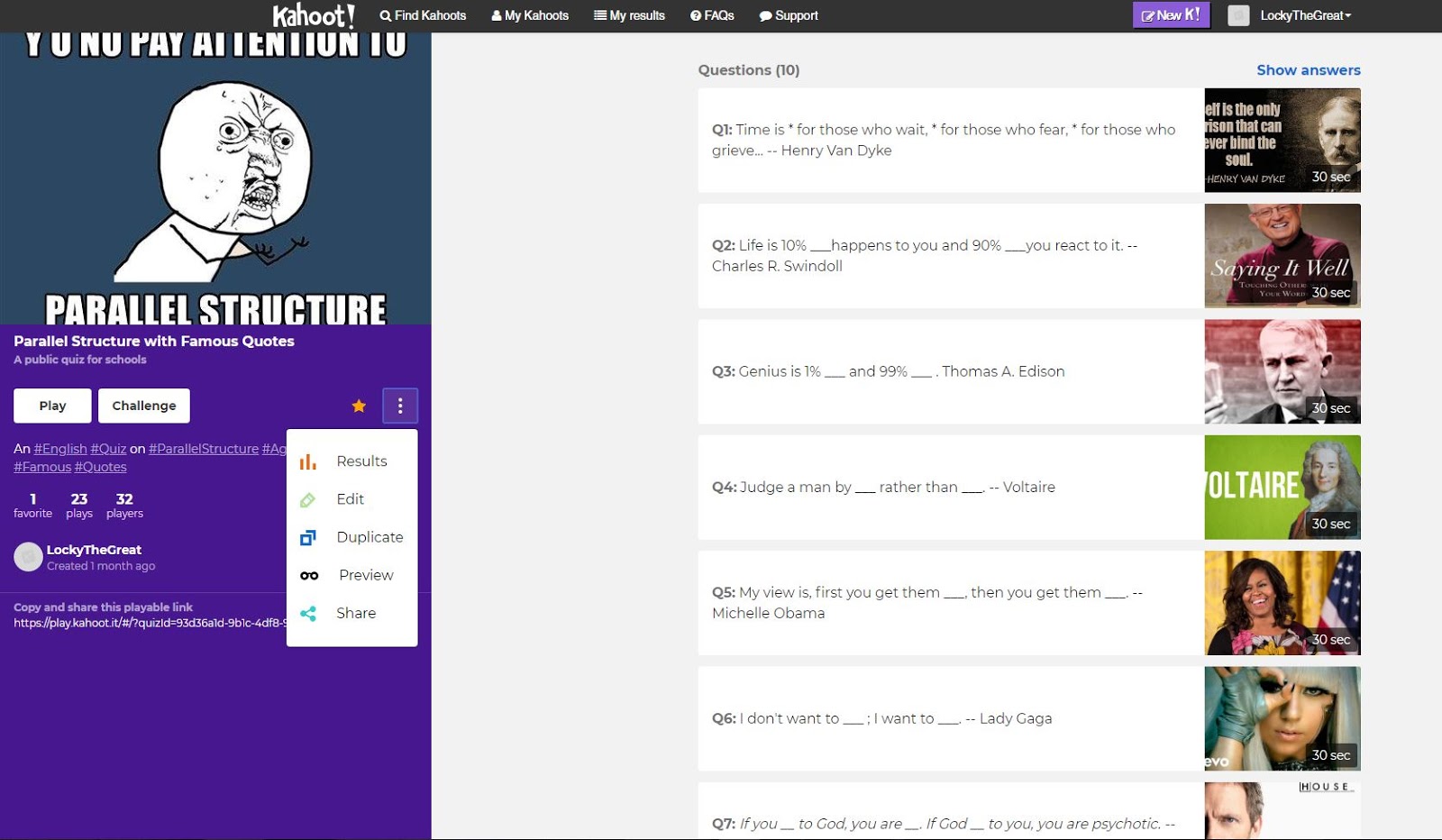
Parallel Structure with Famous Quotes
https://play.kahoot.it/#/k/93d36a1d-9b1c-4df8-9322-bbabeb3f6235

Sentence Structure with Famous Quotes
https://play.kahoot.it/#/k/d4f0bbc3-cbab-48e0-9d27-66e3f65e4018

Synonyms and Antonyms for IELTS Preparatory
https://play.kahoot.it/#/k/a12700ba-8b77-416b-8c8a-9bf65aeeb39a

Monday, 12 June 2017

Usage and Website: Hong Kong Observatory Will Consider Issuing... WHAT????

Image from HKO

Imagine your lover tells you,

"I will consider telling you that this 5-star restaurant ABC is the place for our dinner in the next few hours."

What the hell does that really mean?

Haven't they already told you? Why would anyone decide to consider doing something later?

As we see, there are two obvious main verbs in here: 'consider', 'tell / issue', but there are at least two other hidden in the process, and those are 'decide' and  'inform'. The fact that you are hearing this line from your lover is because your lover has already completed these two hidden processes:

  1. has thought over or pondered and finally 'decided' to do 2
  2. has 'decided' to 'inform' you about 3.
And what is 3?

3. is that they will do two more things: 'will consider' and 'tell you' about something. Has 'will consider' semantically, grammatically and automatically mean 'yes' nowadays?

So the whole line should be read as,

"I have decided to inform you that I will consider telling you that this 5-star restaurant ABC is the place for our dinner in the next few hours."

When this is substituted back to the Hong Kong Observatory's official announcement:

"The Observatory have decided to inform you that we will consider telling you about the hoisting of Typhoon Signal No. 8 in the next few hours."

So, HKO, you sound like you have made up your mind, but have you really?

If you will issue, say you 'will issue'!! I hate hedging like yours!


Reference:
Hong Kong Observatory


Friday, 22 August 2014

Usage & Writing: What On Earth Is "(In) Care Of"?


How to use "c/o"?
Image from WikiHow

Was suddenly asked about "care of", a term which I myself have never used, and so the best way to find out is to Google it.

First link popped out was one from Wiktionary, an example goes,

"(mail) For distribution by (the named intermediary).
Could you please send this package to Mr. John Smith, care of the Northwest Shelter?"


The question is, who is the distributor and who is the intermediary?

Its description was written in a highly professional way,

"Care of, usually abbreviated as c/o on envelopes, signifies an intermediary who is responsible for transferring a piece of mail between the postal system and the final addressee. For example, when the addressee has no standard address, is under a corporate mail system, or is being manually forwarded mail sent to a more accessible location. In Australia and New Zealand c/- is often used in place of ℅."

Definitely not an easy paragraph to read.

As a result, let's return to the dictionaries.

Cambridge Online Dictionaries shows,
Image from Cambridge Dictionaries Online
Clear as days!!! So we have our answer!

The forumla goes,

<recipient> in care of <address of sb else where you can receive>

Oxford Dictionaries Online, despite showing the same explanation, requires careful scrolling and manual searching before you can find what you want.
Image from Oxford Dictionaries Online 
Cambridge wins again!


Resources:
Care of @ Wiktionary
http://en.wiktionary.org/wiki/care_of

How to Address an Envelope in Care of Someone Else
http://www.wikihow.com/Address-an-Envelope-in-Care-of-Someone-Else

http://dictionary.cambridge.org/dictionary/american-english/in-care-of?q=in+care+of
http://www.oxforddictionaries.com/definition/english/care?q=in+care+of

Wednesday, 14 May 2014

Academic Research & Usage: Firstly, Secondly, Thirdly, Even Fourthly Sounds Right, But What About Fifthly and Sixthly?


Ever wondered how we should say what's after "firstly, second, thirdly, fourthly"?
Image from ©iStockphoto.com/SparkleArt

Sorry guys, was too busy meeting the deadline for my term paper marking—yes marking. I literally vomitted gallons of blood in the process. Shocked at the level of written English level of the local Hong Kong students, which makes me understand why the universities want more students from mainland China.

In the process of marking, I came across these very common adverbs, "firstly","secondly", "thirdly", and some not so common such as "fourthly", "fifthly" and "sixthly".

Immediately, I can tell something does not sound right. I have heard of "firstly" all the way up to "fourthly", but not "fifthly" and on. It just sounds strange phonetically to me, which is why I prefer to use "first", "second", "third", "fourth", "fifth", "sixth" and so on if I expect the sequence to be longer than 4.

But the real question is, can we really use "fifthly", "sixthly" or even higher? And if we can, how popular are they as compared to the version without the suffix "-ly"?

Let's do a quick and easy search on BNC to see what the corpus say.


Data from BNC
Images from COCA and Locky's English Playground

What is intriguing is that, there are more "secondly" than "firstly". Why? The reason is pretty simple, because you can use "first" or "first of all" instead of "firstly" to start the sequence.

Data from BNC
Images from COCA and Locky's English Playground
Considering "first of all" alone without considering "first" (since "first" will also appear with "second"), adding 1377 to 1688 from "firstly", we get 3065, and it is already more than 2810 of "secondly". Makes perfect sense.

Another interesting observation is, although you will expect the counts to drop as you go down the list, the "secondly--thirdly" drop is 72.2% while the "thirdly-fourthly" drop is around the same at 73%.

Once it gets to "fifthly", the count drops way below triple digits at 37 per 100 million words.

In other words, if we do a rough calculation, for every 22 writers in the UK, about 12 of them will use "firstly" while the other 10 will use "first of all" -- that is almost half-half; 21 of them will use "secondly" to talk about the next point, that's almost all of them (of course, otherwise, why would they want to say "first of all" or "firstly" if they do not have a second point); 6 of them will continue using "thirdly" whereas only 1 of them will use "fourthly".

Is "fifthly", "sixthly" and so on used in British English? Yes. Frequently? Definitely no.

Similar case is observed for American English.


Data from COCA
Images from COCA and Locky's English Playground

A huge difference between the American English and the British counterpart is that the Americans love to use "first of all" much much more than they use "firstly", exactly 34.8 times more, and they also tend not to use "fourthly" as there are only 37 instances per 450 million words, that is equivalent to 37 / 4.5 = 8 instances per 100 million words, much less than the use of the same word by the British at 137 instances per 100 million words, which implies that the British might like to count to "fourthly" much more than the Americans do.

Both the BNC and COCA shows that the native speakers do not go beyond "tenthly".

And just in case you are asking why there are 2 counts in "eighthly",
Examples of 2 counts in "eighthly"
Images from COCA and Locky's English Playground
because one of the instance is a name and not a sequence count.

Last but not least, if you are wondering which punctuation marks should I use before I write "firstly", "secondly", "thirdly", etc. Here's the tip:

Punctuation mark before "firstly"
Images from COCA and Locky's English Playground
Punctuation mark before "secondly"
Images from COCA and Locky's English Playground
Punctuation mark before "thirdly"
Images from COCA and Locky's English Playground
Punctuation mark before "lastly"
Images from COCA and Locky's English Playground
So, it is quite obvious to us that full-stop (.) is number 1, followed by comma (,) and then semi-colon (;).

Finally, I give you the counts of "lastly" and "last but not least" ("finally" is left out because it can appear in other non-sequential sentences).

"lastly" in American English
Images from COCA and Locky's English Playground

'lastly" in British English
Images from COCA and Locky's English Playground
The numbers for "lastly" in American English is bigger, but if you consider instances per 100 million words, then it only has 1175 / 4.5 = 261 instances per 100 million words, less than the 425 instances per 100 million words in British English.

'last but not least" in American English
Images from COCA and Locky's English Playground
'last but not least" in British English
Images from COCA and Locky's English Playground
Using similar calculation, 268 / 4.5 = 82 instances per 100 million words in the American English, which is more than 52 instances per 100 million words in the British English.

Looking at both the results of "lastly" and "last but not least", we can say that in American English, "last but not least" is more common whereas "lastly" is more common in British English.

Summarizing the points, we get:

American English

  • First of all,
  • Secondly,
  • Thirdly,
  • Last but not least,

British English           


  • Firstly
  • Secondly
  • Thirdly,
  • Fourthly,
  • Lastly,

Bear in mind that nothing is absolute in this universe and the above analysis can be easily challenged in many ways, some of which are,
  • "How do you know the words are not appearing when there is no sequence concerned?" Or,
  • "Don't languages change with time?" Or,
  • "BNC's data are from 1980s-1993, COCA's data are from 1990-2012, don't you think your comparisons are not fully accurate?"
  • And many more.
But if you are asking these questions, you should first learn more about corpus and its creation. In short, the results from the analysis can be an excellent reference, and you know what "reference" means.


Resources:
thirdly, fourthly @ WordReference Forums
http://forum.wordreference.com/showthread.php?t=915022

sixthly @ WordReference.com Dictionary of English
http://www.wordreference.com/definition/sixthly

Firstly, Secondly/First, Second @ WordReference Forums
http://forum.wordreference.com/showthread.php?t=575644

Firstly, secondly, thirdly, etc. @ Grammarist
http://grammarist.com/usage/firstly-secondly-thirdly/

Corpus of Contemporary American English (COCA)
http://corpus.byu.edu/coca/


Thursday, 12 December 2013

Culture & Usage: "Lufsig", False Friends & Bad Words


Lufsig -- a must-buy in Hong Kong
Image from IKEA
"What should we do this Christmas?" 
"Let's throw something!"
"Throw a party?"
"No, throw Lufsig!"

If you are not aware of the recent news from Hong Kong, or you are not into Hong Kong cultures, you probably won't get the above conversation, but in fact, it is packed with dark humour and politics.

Lufsig on its way to attack CY Leung
Image from Mingpao

Lufsig, an IKEA plush toy from the tale of Little Red Riding Hood, has become a recent phenomenon in Hong Kong. Ever since the unknown toy was thrown at the much criticised 'Wolfman' Chief Executive of Hong Kong CY Leung, the toy sparked an immediate craze in the city. Overnight, 'Lufsig has been sold out at all Ikea stores.' Netizens who wish to purchase the popular toy have to place bid on Yahoo! Auction at almost quadruple of the original HK$58.


Image from Yahoo! Auction

There are several reasons to this,

  1. Chief Executive CY Leung, commonly known as 'Wolfman' for his cunningness and absence of integrity, fits perfectly with Lufsig's character -- "fond of play and mischief".
  2. Lufsig's China website translate the name into Cantonese "Lo Mo Sai", which resembles the profanity "mother's cxxt".
  3. Adding to the profanity, "Throwing" or "Hanging" "Lo Mo Sai" resembles "fxxk mother's cxxt".
  4. The plush toy comes with an old granny toy which can be "eaten" by Lufsig and "rescued" from its tummy. Either way, she's someone's mother.
  5. There are just too much unhappiness and pressure among the Hong Kongers towards the government, especially without the right to choose their leader and continual suppression in freedom of speech. Lufsig offers a marvelous mean for stress relief and voice out.

"Lo Mo Sai" -- Lufsig on IKEA China on 11th Dec 2013
Image from IKEA China
The Lufsig phenomenon has led to an explosion of creativity. Not only does Lufsig have a Facebook account, there are also Lufsig throwing competition, Lufsig monster cards, Lufsig posters, selfies with Lufsig, and many more in progress. As BBC reports, "Ikea toy wolf becomes Hong Kong protest symbol".

"Lo Fuk Sai" -- Lufsig on IKEA China on 12th Dec 2013
Image from IKEA China

A spokesman from the IKEA headquarters in Sweden later said, "Our intention is that product names should not reflect politics or religion" and so they have given a new Chinese name to Lufsig -- "Lo Fuk Sai", which worsen to "Aggressively Fxxk (Someone's) Cxxt".

Nice job IKEA!!!


False friends in a Dutch advertisement actually meaning "Mama, that one, that one, that one ..." "Please.", In English this could easily sound as though the child is telling her mother to die, although the word is not pronounced the same way in the two languages.
Caption from Wikipedia, image from thingamababy

False friends as funny as Lo Mo Sai isn't solely a Cantonese thing. In the above Dutch advertisement, "Mama, die, die, die...""Alsjeblieft", actually means "Mama, that one, that one, that one...""Please" in English, but which English speaker will realise the Dutch meaning when the kid in the ad looks like she wanted to kill someone?

Asking around the Hong-Kongers and you'll find out that one of the most classic false friend examples happens in Thai-Cantonese homonyms. A video on the internet shows martial art master Tony Jaa teaching Thai to two Hong Kong artists, pronouncing
  • Colour (English) = See (Thai) = Shit (Cantonese)
  • White (English) = See-Kou (Thai) = Lion's Ball (Cantonese)
  • Pinkish Blue (English) = See-Fa (Thai) = Ass (Cantonese) / 
  • Green (English) = See-Keau (Thai) = Shitty Idea (Cantonese) 
  • Brown (English) = See-Nam-Dang (Thai) = Whatso-fxxking-ever (Cantonese)
  • Black (English) = See-Dom (Thai) = ????
  • Rainbow Colours (English) = Lei-Lai-See (Thai) = You shit (your pants) involuntarily / You have fecal incontinence!!


False friends exists in all languages, wanna learn some false friends in German? Try BBC German!

You might have realised that the more foul false friends are, the more intriguing it gets. That's because humans naturally need foul language. Michael of Vsauce has a rather detailed video about bad words.


So bad words / foul languages are not as simply as they seem.

Their history and evolution has much to do with the class differences. The higher class used elegant words, the lower class used less classy words which some eventually turned into bad words we use today.


And why do we like bad words? Because we can use them as a mean of lalochezia. Lufsg as anti-government symbol? Now you know why.

Enjoy researching!


Vocabulary:
dark humour -- (n)[U] Humor that is viewed as dark, morbid, cruel, offensive to some, and or graphic in nature and is yet, still found funny.
fecal incontinence -- (n)[U] Fecal incontinence (FI), also called faecal incontinence, bowel incontinence or anal incontinence, is a lack of control over defecation, leading to involuntary loss of bowel contents—including flatus, liquid stool elements and mucus, or solid feces.
lalochezia -- (n) [U] (rare) The use of vulgar or foul language to relieve stress or pain.


Resources:

Lufsig @ Facebook
https://www.facebook.com/Lufsig?ref=nf

Lufsig @ IKEA China
http://www.ikea.com/cn/zh/catalog/categories/departments/childrens_ikea/children/

Ikeagosedjur i Hongkong-protester @ GP
http://www.gp.se/ekonomi/1.2205428-ikeagosedjur-i-hongkong-protester

IKEA Toy Wolf Becomes Unlikely Anti-Government Symbol In Hong Kong | Yuen Chan @ Huffington Post
http://www.huffingtonpost.com/yuen-chan/lufsig-hong-kong_b_4414080.html

Toy wolf with a rude name becomes a must-have for Hong Kong protesters @ South China Morning Post
http://www.scmp.com/news/hong-kong/article/1377007/toy-wolf-rude-name-becomes-must-have-hong-kong-protesters

Cuddly wolf sinks teeth into Leung @ The Standard
http://thestandard.com.hk/news_detail.asp?pp_cat=11&art_id=140470&sid=41100584&con_type=1

Vocabulary: Jargons With A Hong Kong Flavour @ Locky's English Playground
http://lockyep.blogspot.hk/2012/07/vocabulary-jargons-with-hong-kong.html

Ikea toy wolf becomes Hong Kong protest symbol @ BBC News
http://www.bbc.co.uk/news/world-asia-china-25314580

Ikea toy wolf Lufsig gets new name after its claim to fame @ SCMP
http://www.scmp.com/news/hong-kong/article/1378290/ikea-toy-wolf-lufsig-gets-new-name-after-its-claim-fame

False Friends @ Wikipedia
http://en.wikipedia.org/wiki/False_friends

What's so funny about German? -- False Friends @ BBC
http://www.bbc.co.uk/languages/german/comedy/false_friends.shtml

Tony Jaa 教泰文(森美、吳君如主持),笑到你lai屎。 @ YouTube
http://youtu.be/3RQ07P4qbGA

Kari Byron No Pain No Gain H O T @ YouTube
http://youtu.be/etl3frIvLEY

http://www.urbandictionary.com/define.php?term=dark%20humor
http://en.wikipedia.org/wiki/Fecal_incontinence
http://en.wiktionary.org/wiki/lalochezia