WORLD OF HYDROGEN

Using wind and solar power, NASA plans to produce fuel for a hydrogen-powered Cleveland bus to demonstrate what may be an ultimate in renewable energy.


 Don't believe it? Watch it for yourself!!!! Click here!!
Thinking about clean fuel like I do?
Natural gas, petroleum, coal are out due to the carbon dioxide (CO2) they emit during combustion. Solar power (energy from sun), hydropower such as tidal power and wave power, and wind power are among my favourite ones because they cause no greenhouse gases, but they next level, is definitely the eco-friendly hydrogen power!!!
Hydrogen is a gas lighter than air, exists in a huge amount on our planet in the form of water (H2O). During the combustion of hydrogen in air, it will release a great amount of energy together with and only water. Because of this, "some environmentalists believe a hydrogen economy could greatly reduce the emission of carbon dioxide and therefore play a major role in tackling global warming." [1]
I wish this day will come sooner! How I wish to breathe fresh air even when I am standing behind a heavy trunk or dirty lorry!
If hydrogen is so great, then why haven't we been using it all along? The reason lies in the practicality of the production:
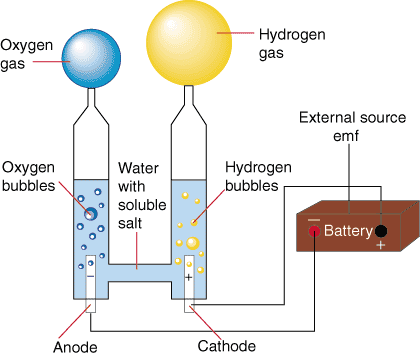
ELECTROLYSIS OF WATER
"Hydrogen must first be broken out from its compound form with oxygen as water (H2O) using electrolysis or gathered by other means as it does not naturally occur by itself. Hydrogen cannot be mined or drilled as with fossil fuels and requires more energy input to produce it than is generated with its combustion." [2]
In simple words, it means that it will take more energy producing hydrogen than the energy hydrogen will produce later. Metaphorically I put it, it is like spending $100 to make $90. (Do you know why this is the case?)
So it was both practically and economically unbeneficial, but not anymore!!!
From Discovery News, "The project, spearheaded by NASA's Glenn Research Center in Cleveland, Ohio, would use power produced by a windmill and solar energy cells to run a machine called an electrolyzer that splits water molecules into its base elements of hydrogen and oxygen. The hydrogen, in turn, would be used as fuel for specially-equipped buses."[3]

 Don't believe it? Watch it for yourself!!!! Click here!!
And the economical benefits?
"The idea is that you'd stimulate jobs for the community by folks learning how to build these devices, how to operate them and also what you could use hydrogen for," said Valerie Lyons, a program manger at NASA Glenn. "Maybe people would make forklifts and other small vehicles that run off hydrogen, or convert gasoline-powered cars.
"There's a lot of things that could simulate the economy with different types of jobs spinning off from the hydrogen economy."[4]
Still driving the old dusty money-eating dudes? Think green! Think cheap! Think clean! Say "Aloha!" to the new hydrogen era!!!!!
Citation:
Resources:
http://dsc.discovery.com/news/2009/05/06/hydrogen-electrolyzer.htmlPicture resources:


 You see the picture on the left? That is a