Hi guys!
This is a greeting from me, hanging out in a great internet cafe inside Siam Paragon right now. My hotel is a really cool one! And I was lucky enough to get a free-upgrade to the executive room!!!! Sweet!!! I will definitely write about that when I am back. Haven't got the chance to use the swimming pool yet, probably tomorrow.
The weather is great here! Around 33 degree Celsius.
The air is not so great though, filled with some kind of smell of burning woods. I experienced the same when I was in Singapore because Indonesia's forests were burning hot!
Just had one oil massage and it was great! Now every inch of my muscles got the relaxation that it deserves long ago.
How is everyone doing?
Have you been keeping yourself busy reading my articles?
I hope you have.
I know you are all in a holiday mood right now, so just bear a few more days and Christmas will be just round the corner!
Do miss me!
Cheers!
Locky

Languages are tunnels that lead to the worlds of infinite knowledge (so have fun with the English language!) -- Locky
Thursday, 17 December 2009

Wednesday, 16 December 2009
Usage: Transitive & Intransitive Verb
When working with the verbs (especially when looking up the dictionary), one must be attention to the words transitive and intransitive.
A transitive verb is a verb which needs an object.
An intransitive verb is a verb which doesn't need an object.
For example:
Verb "lack" is a transitive verb because it must follow directly by an object. (In Cambridge Dictionary Online, you will see [T].)
eg. He lacks judgement. (for 'judgement' is a noun in the object position)
eg. He lacks the will to live. (for 'the will to live' is a noun-phrase in the object position)
**************************************************************
Verb "come" is an intransitive verb because it must NOT follow by an object. (In Cambridge Dictionary Online, you will see [I].)
eg. Whenever you call him, he comes. (no object, just a full-stop)
eg. Come in! (no object, just a preposition)
**************************************************************
In case you want to go further, there is another word called 'ditransitive', 'di-' means '2', thus a ditransitive verb will need 2 objects (one direct object and one indirect object). (In Cambridge Dictionary Online, you will see [+ 2 objects].)
eg. I sent you a present. (Direct object = a present; Indirect object = you)
**************************************************************
Don't forget these!!!! They are very important to your English usage foundation!
Resources:
Monday, 14 December 2009
Vocabulary: Christmas Stuff
Early Merry Christmas to you all!
Okay, Christmas is just round the corner, have you completed your Christmas shopping? Well, I hope not, because if you have done so before reading this entry, you would have missed your chance of learning some vocab in the process, which I always believe, is a much better and interesting way than reading these words from my entry (do you think so?), but even if you haven't done the shopping, I hope you can keep these words in your pocket and remind you of them every time you see them. That should help you remember a lot easier!

Mr Bean -- Christmas Turkey @ YouTube
http://www.youtube.com/watch?v=aFgLrWiNHFc
http://lockyep.blogspot.com/2009/10/vocabulary-wicked-wicker-wig-makes.html
Right, let's begin our list of vocabulary:
-- the red and green leave plant for Christmas

-- There are many types of trees used but the most common type is Fir (other than plastic).
Christmas ornaments -- things you put on the Christmas tree


Christmas Cracker(UK), bonbon(US)-- Garland / Wreath, usually tinsel, is the long pieces of thin shiny material used as decoration on trees. Tinsel also has a negative metaphorical meaning, click here to see.
 |
| Garland / Wreath Image from image.made-in-china.com |

 |
| Tinsel Image from acornclass.files.wordpress.com |

-- a tube of brightly coloured paper given at Christmas parties, which makes a noise when pulled apart by two people and contains a small present, a paper hat and a joke.
See how Mr Bean uses his modified Christmas crackers:
-- song or hymn which is sung in the period before Christmas.
 |
| Image from peterboroughtoday.co.uk |

Watch the ingenious Mr Bean and his incredible Christmas Carol:
-- Obvious from the names, but you can read their history by clicking onto the names above.
 |
| Image from 0.tqn.com |

-- You wear the stocking and wear the turkey??? The mashed up substance that Mr Bean was stuffing into the turkey's bottom is called Turkey stuffing.
Christmas cake of Yule log
-- a Christmas cake of the shape of a wooden block, appear mostly in European countries.


-- a basket made of wicker , with food and gift inside. A great way to earn money in the commercial world.
 |
| Image from wyndarra.org.au |

Do "like" this article and our English Playground!
Resources:
Mr Bean -- Christmas Turkey @ YouTube
http://www.youtube.com/watch?v=aFgLrWiNHFc
http://lockyep.blogspot.com/2009/10/vocabulary-wicked-wicker-wig-makes.html
Friday, 11 December 2009
Animal: Save the Bluefin Tuna (Amended)
Animal: Save the Bluefin Tuna

This Christmas, when you are happily enjoying your meals on a romantic candlelit table, do not forget to think about what you are eating, it may just be one of those endangered species. Since the first time I wrote about saving the humpback whales, then the clever sharks, followed by the leatherback turtle, I suppose you know many of the animals on this planets need our attention and need us to learn more about them so that we can appreciate their living. I have always been an environmentalist and I love this planet, and so I hope you do too! This time, I would like you to care for the poor bluefin tuna.

Bluefin Tuna Interesting Facts
- They are listed as "Critically Endangered".[1]
- All tunas are warm-blooded, like human.[3]
- The Pacific bluefin tuna is are some of the biggest and fastest fish in the Pacific Ocean.[3]
- Three species of this oceanic giant: southern bluefin tuna (global Southern Ocean), Pacific bluefin tuna (Indo-Pacific Ocean), northern bluefin tuna (Atlantic Ocean and Mediterranean Sea) have been largely fished out to satisfy our insatiable taste buds.[1]
- It takes about 8 to 14 years for northern and southern bluefin tuna to mature and about 3 to 5 years for Pacific tuna[1] , with a maximum lifespan believed to be about 25 years [3].
- Since the 1970s, populations of the northern bluefin tuna have declined by almost 90% while southern bluefin tuna have declined by about 85%.[1]
- There is currently no quota system and no way of controlling Pacific bluefin tuna fishing in international waters. A large number of immature Pacific bluefin tuna juveniles are caught by small, local fisheries in Japan, pushing this population close to the endangered category.[1]
- The northern bluefin breeding population will disappear by 2012 unless the current fishing frenzy stops.[1]
What can you do?

You can come here to pledge to be a "Bluefin Saver" by visiting this website by WWF and choose the restaurant(s) from whose menu you want the bluefin tuna to be removed. I have already done so.
Vocabulary:
insatiable -- adj. (especially of a desire or need) too great to be satisfied
immature -- adj. not yet completely grown
juveniles -- n. young people, hereby refers to fish
fisheries -- n. areas of water where fish are caught so they can be sold
breeding -- vb. [I] (of animals) to have sex and reproduce
frenzy -- adj. uncontrolled and excited behaviour or emotion, which is sometimes violent
pledge -- vb. to make a serious or formal promise to give or do something
Picture resources:
http://www.sea-way.org/blog/Bluefin_Tuna_03.JPG
http://www.wwf.org.hk/images/conservation/seafood/bluefintuna/e-bluefin-ill.jpg

Resources:
Wednesday, 9 December 2009
Economics: Double dip warning
Some of you who have followed my blog right from the very first few entries should know that my favourite economist is no other than the winner of the 2008 nobel memorial prize in economics, Paul Krugman. In the past, I have recommended his book, the Return of Depression Economics and the Crisis of 2008, as well as his blog on the New York Times website, and surely you must have benefited a lot from his brilliant insight (and his humorous English).
I like this line he made the best, "When life hands you Lehman, make Lehman aid."
Well, recently, I read something really horrifying! Titled"Double dip warning", the article goes as follows (highlighting the crucial information):
******************************************************
Double dip warning
I’ve never been fully committed to the notion that we’re going to have a “double dip” — that the economy will slide back into recession. But it has been clear for a while that it’s a serious possibility, for two reasons. First, a large part of the growth we’ve had has been driven by the stimulus — but the stimulus has already had its maximum impact on the growth of GDP, will hit its maximum impact on the level of GDP in the middle of next year, and then will begin to fade out. Second, the rise in manufacturing production is to a large extent an inventory bounce — and this, too, will fade out in the quarters ahead.
Two stories this morning highlight the risks. The WSJ has a report on highway construction titled Job Cuts Loom as Stimulus Fades:
Highway-construction companies around the country, having completed the mostly small projects paid for by the federal economic-stimulus package, are starting to see their business run aground, an ominous sign for the nation’s weak employment picture.
Meanwhile, the ISM for manufacturing suggests that industrial growth is already slowing down.
I’d be more sanguine about all of this if there were any indications that private, final demand is taking off — consumers, business investment, whatever. But I haven’t seen anything suggesting that sort of thing.
The chances of a relapse into recession seem to be rising.
******************************************************
Then he wrote a few more articles, "Good news is bad news", "Bernake does a bad, bad thing" showing evidence that this is not going to be good.
For those of you who cares about the world of money, be vigilant.
Vocabulary:
Sanguine -- (of someone or their character) positive and hopeful
Vigilant -- always being careful to notice things, especially possible danger
******************************************************
Resources:http://lockyep.blogspot.com/2009/03/book-return-of-depression-economics-and.html
http://lockyep.blogspot.com/2009/06/blog-investment-paul-krugmans.html
http://krugman.blogs.nytimes.com/2009/12/01/double-dip-warning/
http://krugman.blogs.nytimes.com/2009/12/04/good-news-is-bad-news/
http://krugman.blogs.nytimes.com/2009/12/04/bernanke-does-a-bad-bad-thing/
Monday, 7 December 2009
Investment: What's after Solar? Wind Power
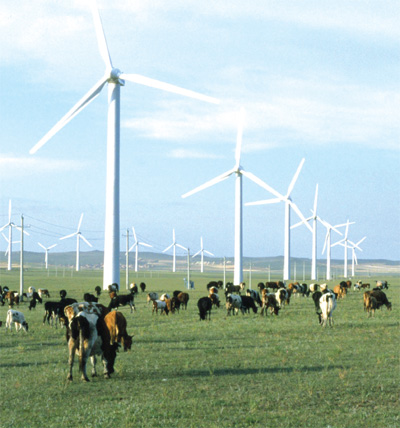
What's after Solar? Wind Power
As some of you might still remember that I have written 3 articles (part 1, part 2, part 3) on why I seriously consider solar power to be a better alternative than wind power, but that doesn't mean I do not admire the power of the wind.
Support for the wind power industry
On the 26th November, Beijing announced that it aimed to boost the country's energy efficiency as part of its contribution to the fight against global warming. China pledged to cut carbon dioxide (CO2) emissions per unit of gross domestic product by between 40% and 45% by 2020 compared with 2005 levels. [1] And what do you think will contribute to this large reduction in CO2?
Charm of Longyuan
As the IPO (international public offering) of Asia's largest wind power generator, China's Longyuan Power Group, drew to a close, locking in over HK$200 billion for its 230 times oversubscription and making its IPO this year's fourth-largest deal in terms of frozen liquidity[2], Hong Kong environmentalists finally have the channels to play a part in healing the world through investing in the largest solar and wind power companies in Asia. (Why Investing in these companies allows you to participate in saving the world?[3])
The attraction of Longyuan Power is more than obvious. Longyuan Power has charmed cornerstone investors such as the China Investment Corp. (CIC), WL Ross & Co. LLC, founded by billionaire Wilbur Ross, and companies linked to China Life Insurance Co., Bank of East Asia Ltd. Chairman David Li and Hong Kong-based asset manager Value Partners Group Ltd.[4]
Riping Fruit
But all these come nothing close to the importance of the company's fundamental, and the good news is, the fruits are riping. In simple words, since in the wind power business, constructions require a lot of starting capital, but once the facilities are installed, wind starts turning the turbines and electricity starts generating and money starts following in. Quoting from the prospectus of Longyuan, "its operating profit as a percentage of our total operating profit increased substantially from 13.3% in 2006 to 69.4% for the six months ended June 30, 2009"[5], "For the years ended December 31, 2006, 2007 and 2008 and the six months ended June 30, 2009 ...our wind power business’s operating profit accounted for 13.3%, 39.6%, 75.7% and 69.4%, respectively, of our total operating profit, and its adjusted operating margin (as defined below) amounted to 32.9%, 45.8%, 53.9%, and 56.5% during those periods."[5](page 11)
Problems faced by the wind power industry
Government has full support for this renewable energy industry so I am not worried about the future of this company at all. The only thing I am more concerned is what I have read from Discovery New, that as global warming continues to worsen, wind speed is actually slowing down across the globe[6], and if the turbines do not move, there is no power. You might think it is quite impossible for wind completely not to blow -- which is true, but in the long run, it seems that wind will keep losing its speed[7]. Solar power will not have similar problem.
Either too strong or too weak of the wind speed is not beneficial for the wind power companies. Looking carefully through the prospectus of Longyuan, you will find on page 40 that, "Currently, wind turbines will only begin to operate when wind speeds reach a certain minimum (approximately three to four meters per second), and must be disconnected when wind speeds exceed a certain maximum (approximately 20-25 meters per second). Therefore, if wind speeds are outside these limits, the electricity output from our wind farms will decrease or cease."[5] Which is another reason why I prefer solar to wind power.
Pricing of Longyuan
Some said Longyuan is offering its shares at 16 to 19 times the year 2010 Price-to-Earning ratio (PE)[8], some said 28.9 times [9], the difference is quite large, so whatever it is, there is certain risk in this investment, so the question is, how strong is your belief in your investment decision?
Hereby I leave you with the wise words of Benjamin Graham, which might have been read by Warren Buffett also,
"You're neither right nor wrong because other people agree with you. You're right because your facts are right and your reasoning is right—and that's the only thing that makes you right. And if your facts and reasoning are right, you don't have to worry about anybody else."
Vocabulary:
pledge -- to make a serious or formal promise to give or do something
lock in -- to make money not able to be moved / flowed around in the market
oversubscription -- The excess number of shares or bonds that investors want to buy but are not available due to high demand.
frozen liquidity -- money which is not able to be moved for a period of time
play a part in -- to help to achieve something
charm -- to attract someone or persuade someone to do something because of your charm
cornerstone investors -- investors of great importance which everything else depends on
substantially -- to a large degree
cease -- to stop something
Picture resources:
Resources:
http://lockyep.blogspot.com/2009/10/investment-electric-cars-vs-future-part.html
http://lockyep.blogspot.com/2009/10/investment-electric-cars-vs-future-part_28.html
http://lockyep.blogspot.com/2009/10/investment-electric-cars-vs-future-part_30.html
Subscribe to:
Posts (Atom)