Friday, 17 February 2012

Learning Method & Vocabulary: Post-Valentine's Sugar & Sweet


Article 3 on Singtao Student Page:


Valentine's Day has ended but learning has just begun. This week, I will share with you a memorisation method and some new words.

Sugar is all sugar and spice to Gingy
Image from vkontakte.ru
Dear lovely readers, hope you and your parents had an excellent Valentine's Day!

Valentine's Day is a day of  "sugar and sweets" and thus everyone deserves to have their share of loving moments, if you still have not had the time to celebrate this marvellous day, you had better make it up to your love ones this weekend or Sunday.

As for me, Valentine's Day has not only offered me a reason to love, but a cue to learn. This time, I am interested in words to do with "sugar" and "sweet" in love and relationships.

One of the memory techniques I love to use after looking up new words in a dictionary is to create examples which I find easy to remember, funny or ridiculous ones work best for me -- I call this Memorisation By Examples (MBE). Its effectiveness, like all memory techniques, depends on individuals. However, it is worth a try. If MBE works for you,  at the end of the day you will be able to recall the words and meanings easily for writing and speaking.

Here are some scenarios I have created:
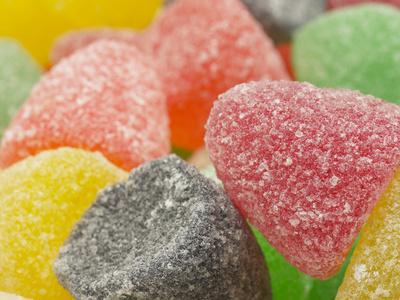
Sugar-coated gum drops
Image from allpostersimages.com

Jane: Why this promise you've just made sounds sugar-coated?
John: Coz it IS a trap and I want you to fall for it.

John: Jane, I'm sorry, I've made a tiny little scratch on your favourite painting.
Jane: Don't sugar the pill! What's the damage?
John: Well, actually, I cut it into 2 halves ...

Jane: I can be sugar and spice to my boyfriend.
John: You? Sugar and spice? I would be vomiting hard if I were him.

Jane: I cooked you your favourite Carbonara for dinner tonight?
John: Sweet!!!

Jane: Have you ever told a sweet lie?
John: No, but here's one, "I love you!"
Jane: I hate you!

Jane: Don't you ever think you can sweet-talk me into trusting you!
John: Well, how about the fact that you let me marry you 10 years ago!

Jane: I bet those two over there are saying sweet-nothings to each other.
John: No, they can never talk romantic, they are brother and sister, says on their Tee-shirts.
Sweet Tooth
Image from deviantart

John: Why do all women have sweet-tooth?
Jane: Coz men aren't sweet enough and so we need to help ourselves with sugary food to stay happy.

John: I'm so sorry! How can I make you happy again?
Jane: If you want to keep me sweet, start by flushing the toilet after use!!!

John: Jane is sweet on all Disney products and her room is packed with them.

John: My childhood was full of bittersweet memories... I was naughty, dad punished me, and then mum punished dad, and I laughed at him every time!


Fun Tasks For You:
  1. Try think of a funny or ridiculous example for "silver tongue" or "silver-tongued".
  2. From now on, whenever you see a word which you think is worth memorising but is very difficult to memorise, try this MBE technique.
  3. Pick any word such as "tongue" or "heart" and see how many related words or idioms there are.

Suggested answer for last week's Fun Tasks: Which words have the same pronunciation as "Q"?
  • cue and queue


Discussion Questions:

  1. With your classmates, share some useful memorisation techniques and discuss their effectiveness.
  2. How many students in your class will need to memorise anything these days? What are they?
  3. The advancement of technology is helping us memorise lesser and lesser. Is that good or bad? Discuss with examples.
  4. Discuss the benefits of practising memorisation, give examples.


Usage:
had better
Had better actually refers to the immediate future and does not involve the past in any sense. It is a strong advice for someone and it is stronger than should and ought.
eg.

  1. You had better stop playing smartphone games!
  2. You had better not whistle at that dog! (note the position of not)
  3. You'd better get out of your bed and get dressed for school now!!!! (note the 'd)


Pronunciation:
Compound verbs and nouns such as sweet-talk and sweet tooth are stressed on the first part of the word whereas adjectives such as sugar-coated and bittersweet are stressed on the second part of the word. However, there are always many exceptions in any languages and learners should take special attention to the pronunciation of each word while looking up words in a dictionary.


Vocabulary:
make it up to sb -- to do something good for someone you have upset, in order to become friends with them again
cue -- (n) [C] a signal for someone to do something
sugar-coated -- (adj) disapproving An announcement or promise that is sugar-coated is intended to seem positive or pleasant, although in fact it will result in something unpleasant or unacceptable.
sugar and spice -- If you describe someone, especially a woman or a girl, as being sugar and spice, you mean that they are behaving in a kind and friendly way
sugar the pill -- UK (US sweeten the pill) to make something bad seem less unpleasant
sweet -- (adj) (informal) Very good; pleasant; agreeable.
sweet lie -- (n) [C] When someone who doesn't truthly have interest in you makes you fall hard for them and you end up with a broken heart. 
sweet-talk -- (vb) [T] informal to talk to someone in a pleasing or clever way in order to persuade them to do or believe something
sweet-nothings -- (plural n) humorous romantic and loving talk
sweet-tooth -- (n)[S] If you have a sweet tooth, you like eating sweet foods, especially sweets and chocolate.
keep sb sweet -- to try to keep someone satisfied and pleased with you
be sweet on sb/sth -- old-fashioned informal to like someone / something very much in a romantic way
bittersweet -- (adj) containing a mixture of sadness and happiness
silver-tongued -- (adj) literary If you are silver-tongued, you speak in a way that charms or persuades people.

Resources:
http://dictionary.cambridge.org/dictionary/british/make-it-up-to-sb#make-it-up-to-sb__1
http://dictionary.cambridge.org/search/british/?q=sugar
http://dictionary.cambridge.org/dictionary/british/sugar-coated_2
http://dictionary.cambridge.org/dictionary/british/sugar-and-spice#sugar-and-spice__1
http://dictionary.cambridge.org/dictionary/british/sugar-the-pill#sugar-the-pill__1
http://dictionary.cambridge.org/search/british/?q=sweet
http://en.wiktionary.org/wiki/sweet
http://www.urbandictionary.com/define.php?term=sweet%20lie
http://dictionary.cambridge.org/dictionary/british/sweet-talk
http://dictionary.cambridge.org/dictionary/british/sweet-tooth
http://dictionary.cambridge.org/dictionary/british/sweet-nothings
http://dictionary.cambridge.org/dictionary/british/sweet-tooth?q=sweet-tooth
http://dictionary.cambridge.org/dictionary/british/keep-sb-sweet#keep-sb-sweet__1
http://dictionary.cambridge.org/dictionary/british/be-sweet-on-sb#be-sweet-on-sb__1
http://dictionary.cambridge.org/dictionary/british/bittersweet_1?q=bittersweet

Adam Sandler Sweet on 'Candy Land' for Sony @ Reuters
http://www.reuters.com/article/2012/01/31/idUS39840534320120131

Practical English Usage by Michael Swan, Oxford

Wednesday, 15 February 2012

Song: How Deep Is Your Love -- Bee Gees


A song for your Valentine's!

I love the sunny atmosphere in the first verse, then the dreamy electronic keyboard. Of course, the signature falsetto and the lyrics, miraculously merged! There won't be another band like the Bee Gees, ever! They are irreplaceable.

I shall not speak more, good wine needs no bush.


How Deep Is Your Love lyrics
Songwriters: Gibb, Maurice Ernest; Gibb, Robin Hugh; Gibb, Barry;

I know your eyes in the morning sun
I feel you touch me in the pouring rain
And the moment that you wander far from me
I wanna feel you in my arms again

And you come to me on a summer breeze
Keep me warm in your love, then you softly leave
And it's me you need to show
How deep is your love

How deep is your love, how deep is your love
I really mean to learn
'Cause we're living in a world of fools
Breaking us down when they all should let us be
We belong to you and me

I believe in you
You know the door to my very soul
You're the light in my deepest, darkest hour
You're my savior when I fall

And you may not think, I care for you
When you know down inside that I really do
And it's me you need to show
How deep is your love

How deep is your love, how deep is your love
I really mean to learn
'Cause we're living in a world of fools
Breaking us down when they all should let us be
We belong to you and me

And you come to me on a summer breeze
Keep me warm in your love, then you softly leave
And it's me you need to show
How deep is your love

How deep is your love, how deep is your love
I really mean to learn
'Cause we're living in a world of fools
Breaking us down when they all should let us be
We belong to you and me

How deep is your love, how deep is your love
I really mean to learn
'Cause we're living in a world of fools
Breaking us down when they all should let us be
We belong to you and me

How deep is your love, how deep is your love
I really mean to learn
'Cause we're living in a world of fools
Breaking us down when they all should let us be
We belong to you and me

Vocabulary:
saviour -- (n) [C] (US savior) UK a person who saves someone from danger or harm
falsetto -- (n) [C] (plural falsettos) a form of singing or speaking by men using an extremely high voice
miraculously -- (adv) from miraculous (adj) very effective or surprising or difficult to believe
irreplaceable -- (adj) too special, unusual or valuable to replace with something or someone else
good wine needs no bush -- (proverb) it is not necessary to advertise well-made goods


Resources:
People: Steve Jobs' 2005 Stanford Commencement Address @ Locky's English Playground
http://lockyep.blogspot.com/2011/03/people-steve-jobs-2005-stanford.html

How Deep Is Your Love @ elyrics.net
http://www.elyrics.net/read/b/bee-gees-lyrics/how-deep-is-your-love-lyrics.html

bee gees how deep is your loveBee Gees - How Deep Is Your Love ( Original ) HQ [ NO CONCERT / NO KARAOKE ] @ YouTube
http://youtu.be/BBMriOspUvA

http://dictionary.cambridge.org/dictionary/british/saviour?q=saviour+
http://dictionary.cambridge.org/dictionary/british/falsetto_1?q=falsetto
http://dictionary.cambridge.org/dictionary/british/miraculous?q=miraculously
http://dictionary.cambridge.org/dictionary/british/irreplaceable?q=irreplaceable+
http://en.wikipedia.org/wiki/Festive_ecology

Tuesday, 14 February 2012

Animals: Theories of Stranded Dolphins & Whales


In the last science news digest entry, I have mentioned that I have some theories on the "suicidal attempts" of the dolphins. I'm sure some marine biologists have already covered these possibilities, but since none of them has made that well-known to the public, I will give it a whirl to offer my views.

First, we must realise that many animals behave in similar ways as human do (if you can recall, Seamore the leopard shark also behaves like a puppy). For a creature as smart as the monkeys, dolphins and whales, I reckon they also do what human beings will do. We play, we chase each other, we socialise, we sing, we chat, we dance, we war, we feel upset, we feel despair and we help each other out.


The Orcas (or killer whales), are the largest of dolphins, are supreme strategic killers which work as a team when hunting. They will not only hunt for food, but they will also go in war with other whale kinds. The following video shows a group of killer whales hunting a young grey whale in the presence of its mother grey whale. Actually, I say it is a war rather than a hunt, because in a war, warriors are cruel and cold-hearted, they share no mercy or sympathy, and their reward is simply death; consuming their kill is not an agenda, humiliating the corpse / carcass and the living is the key.


My theory 1 is FEAR: Since dolphins are related to the killer whales, they should somehow behave like them, or like humans. A group of dolphins is at war with another group, and the weaker group is desperate to retreat to the shallow or even to the beach hoping to escape from the murder. If Lady Luck in on the side of the weaker group, not all of them will die on the beach, some will live, and the stronger group might be stranded and die. The LA Times reported a grey-whales rescue case today, the article states that a young grey whale fled in fright when someone mistakenly played recordings of killer whales, which proves that fear could be a possibility.


In the next video, you will see how skilfully an orca hunt for stingrays in the shallow waters, and like the host said, the orcas are putting their life at risk in the hunting as they could be stung by the stingray, or get themselves stranded in the shallow waters.


Thus my theory 2 is FOOD, the dolphins are hunting for a creature such as shrimps or crabs very special which reside in the shallow waters, and because dolphins are highly-bonded animals, when one is stranded, others will approach the stranded as a group for the rescue, and ends up also being stranded as well.


Theory 3 is SCRATCH, similar to theory 2, the difference is this time it is not for food, but for a nice scrub with the sand to have their parasites removed.


My last theory is SUICIDE, even some people in despair commit suicide, then why won't dolphins and whales do it? But when one decides to end its life for whatever reasons, others will try to save it, just like human doctors, firemen or policemen. The difference is, there are a lot more rescuers than suicidees and the rescuers end up being the victims too.

All the above theories somehow explains why some rescued dolphins will be restranded.

Two extra news on the dolphins, the first report says that because on the day of 9/11 there were no boats at sea, it offered an opportunity for a group of scientists to record data. The data from the right whales shows a link between noise level of the ocean and whale stress, a truly remarkable finding proving that we are making the ocean noisier and more stressful for the whales to live (let's not forget, sounds travel further and faster in liquid). The second report mentions that ocean dolphins are not used to tides and tide turns could get the dolphins stranded, offering yet another reason for the deaths of many beached dolphins.

All in all, not a very good topic on Valentine's Day, but this is meant to be for Monday actually. On this marvellous day, don't just love your lovers, love our oceans and sea animals too!


Vocabulary:
stranded -- (adj) 
suicidal -- (adj) People who are suicidal want to kill themselves or are in a mental state in which it is likely that they will try to do so
marine biologist -- (n)  the scholar of scientific study of organisms in the ocean or other marine or brackish bodies of water.
supreme -- (adj) having the highest rank, level or importance
strategic -- (adj) helping to achieve a plan, for example in business or politics
cold-hearted -- (adj) disapproving showing no understanding for or not feeling sorry about another person's suffering
mercy -- (n) [U] kindness and forgiveness shown towards someone you have authority over
sympathy -- (n) [U] (an expression of) understanding and care for someone else's suffering
humiliate -- (n) [T] to make someone feel ashamed or lose their respect for themselves
corpse -- (n) [C] a dead body, usually of a person 
carcass -- (n) [C] the body of a dead animal, especially a large one that is soon to be cut up as meat or eaten by wild animals
stingray -- (n) a group of rays, which are cartilaginous fishes related to sharks. 
rescue -- (vb)[T] to help someone or something out of a dangerous, harmful or unpleasant situation
scrub -- (vb) [I or T] to rub something hard in order to clean it, especially using a stiff brush, soap and water
despair -- (n) [U] the feeling that there is no hope and that you can do nothing to improve a difficult or worrying situation


Resources:
News, Science & Animals: Science News Digest (6th-9th Feb) @ Locky's English Playground
http://lockyep.blogspot.com/2012/02/news-science-animals-science-news.html

Animals and Environment: Do Sharks Deserve to Die for Their Fins? @ Locky's English Playground
http://lockyep.blogspot.com/2009/05/animals-and-environment-do-sharks.html

Killer Whales @ Wikipedia
http://en.wikipedia.org/wiki/Orcas

Orcas on the hunt @ BBC Nature
http://www.bbc.co.uk/nature/life/Killer_whale#p00k08q8

Killer whale hunt  @ BBC Nature
http://www.bbc.co.uk/nature/life/Killer_whale#p004t03t

Chimps killing and eating a monkey @ YouTube
http://www.youtube.com/watch?v=KTPkmH4hWCs

Stranded Orca rescued in NZ @ YouTube
http://youtu.be/665s4AvHUVU

Dolphins at Bluff Point (Red Sea) 2009 @ YouTube
http://www.youtube.com/watch?v=pJdTLXvQzw8

Unplanned 9/11 analysis links ocean noise to whale stress @ Twincities.com
http://www.twincities.com/ci_19924178

Common dolphin makes uncommon splash in Ocean City @ Press of Atlantic City
http://www.pressofatlanticcity.com/communities/upper_capemay/common-dolphin-makes-uncommon-splash-in-ocean-city/article_675fdf2e-542b-11e1-bd4b-0019bb2963f4.html

http://dictionary.cambridge.org/dictionary/british/suicidal_1?q=suicidal+
http://en.wikipedia.org/wiki/Marine_biology
http://dictionary.cambridge.org/dictionary/british/supreme_1?q=supreme
http://dictionary.cambridge.org/dictionary/british/strategic?q=strategic+
http://dictionary.cambridge.org/dictionary/british/cold-hearted?q=cold-hearted
http://dictionary.cambridge.org/dictionary/british/mercy_1?q=mercy
http://dictionary.cambridge.org/dictionary/british/sympathy_1?q=sympathy+
http://dictionary.cambridge.org/dictionary/british/humiliate?q=humiliate
http://dictionary.cambridge.org/dictionary/british/corpse?q=corpse
http://dictionary.cambridge.org/dictionary/british/carcass?q=carcass
http://en.wikipedia.org/wiki/Stingray
http://dictionary.cambridge.org/dictionary/british/rescue_1?q=rescue
http://dictionary.cambridge.org/dictionary/british/scrub_1?q=scrub
http://dictionary.cambridge.org/dictionary/british/despair_1?q=despair+

Message: Happy Valentine's Day 2012


Haven't got time to finish my Monday entry, so I hope that I can post it later today. As for now,

 HAPPY VALENTINE'S DAY!!!


Friday, 10 February 2012

Slang & Speaking: Speaking Valentine's


Article 2 on Singtao Student Page:


Walking on the streets of Hong Kong as Valentine’s Day draws near, I have some observations to make and advice to offer.
Image from shoppingblog.com
Valentine's Day is just around the corner!  A time for the lovers' creativity to materialise and have your wallets emptied! Before you can even notice it, shops and malls are fully decorated to draw customers in the mood of mega-spending. Love is all around! Young couples hug and kiss every step of the way, presents wielded firmly. Pink hearts, white bears and red roses appear at every angle of eyesight even when your eyes are closed, not having any of these in a girlfriend's hands seemingly indicates a stingy or incapable boyfriend... or otherwise. 


To some, maybe gifts do not matter at all! 

"Having calm and staying a logical mind is what makes a man a man!" (Notice the wrong use of words!)

Image from sakura-hostel.co.jp

Inside that logical mind of this man, he thinks, "Gifts don't matter! Since a real heart is in fact not pink in colour nor is it the shape of two lobeless ears adhered together, polar bears are not cuddly nor naturally friendly to human and their fur is not exactly white, and red roses symbolise nothing but thoughtless, uncaring, and unoriginal as anyone would purchase the same flower for their beloved mother. Gifts are just for showing off! How practical can they be?"

Red Roses
Image from Flowers Photoblog
"It is the thought that counts!" is a cliché some keep in their armoury since their first empty-handed Valentine's Day.

And there is more than just one cliché. 

Take Hong Kong for example, according to my survey through years of observation, boys in Hong Kong overuse the word "baby", and abuse the word "cute". The former confuses me whenever I am near 11th floor of Langham Place in Mongkok, the latter irritates my ears because of the absence of the consonant "t" in its pronunciation.

"Baby! You are so Q!" is what I often heard in English, if any.

Why would any girls still buy this kind of compliment? He's saying you are a stick!!

What about "sweetie", "honey", "darling", "my angel", "my love", "cutie"and "cutiepie"? I understand the goosebumps issue and I am hearing some readers are shouting "Do you mind?" but let's put that aside for now. Where is the variety in the choice of vocabulary?

This might sound nothing related to English speaking or oral examinations but I must say, it is related. Consonant "t" at the end of words is a sound often omitted by students, often unaware of the error. Although arguably perfectly acceptable in some occasions, the absence of consonant "t" such as "cute" transforms the word entirely into a different one. It is crucial to pay special attention to such words when practising your speaking.

Another point is the lack of variety in the vocabulary. The most popular words students conveniently use in the secondary school level are "fine",  "okay", "do", "see", "play", "nice", "good", "happy", "sad", "hot", "cold", "painful", "easy" and "not easy".

Basic vocabulary is for survival English. If you are aiming for better grades in speaking and listening, you will need to start working on the variety.

This is no sweet little lie.
Image from somekindofawesome.com
By the way, if you are the recipient of the compliment, "Baby! You are so Q! I Lub U!" Tell the boy, "Practice your pronunciation at home before ever speaking to me again!" Because how hard he tries to correct his pronunciations is a measurement of how much he means the words he says.


Fun Tasks For You:
  1. Which words have the same pronunciation as "Q"?
  2. Find a total of 10 different terms which have the word "sweet" and "sugar" in it.
  3. Try pronounce "sea" and "seat", "her" and "hurt" and note the difference.
  4. Pick any selected adjectives in the vocabulary section and find words with similar meanings.
  5. Search online for a list of sweet quotes and then ask the boys and girls in your class how sweet these quotes are to them.
  6. Carry out a survey in your class for the list of presents your classmates hope to receive on Valentine's Day.

Discussion Questions:
  1. What are some of the Valentine's Day marketing strategies you have come across?
  2. What does Valentine's Day mean to you / to the society / to other cultures?
  3. What did the past generations do on Valentine's Day?
  4. Are we over-materialistic?
  5. Is materialism gender-specific? Discuss.
  6. How to enjoy a low-budget Valentine's Day?


Vocabulary:
materialize -- (vb) [I] (UK usually materialise) If an idea or hope materializes, it becomes real
stingy -- (adj) informal disapproving unwilling to spend money
incapable -- (adj) unable to do something
or otherwise -- used to refer to the opposite of the word which comes before it
lobeless ear -- (n) [C] a ear with no lobe 
Image from bbc.co.uk
adhere -- (vb) [I] formal to stick firmly
cuddly -- (adj) approving liking to cuddle, or making you want to cuddle
symbolize (UK usually symbolise) to represent something
thoughtless -- (adj) not considering how your actions or words may upset someone
uncaring -- (adj) disapproving not worrying about other people's troubles or doing anything to help them
unoriginal -- (adj) the same as a lot of other things and therefore not interesting or special
cliché -- (n)[C or U] a comment that is very often made and is therefore not original and not interesting
armoury -- (n) (US armory) [C] a place where weapons and other military equipment are stored
abuse -- (vb) [T] to use or treat someone or something wrongly or badly, especially in a way that is to your own advantage
the former -- (n)[S] the first of two people, things or groups previously mentioned
the latter -- (n)[S] the second of two people, things or groups previously mentioned
irritate -- (vb)[T] to make angry or annoyed
cutie -- (n) [C] (also cutiepie) mainly US informal a woman or girl who you consider attractive or like a lot
goosebumps -- (n) plural noun (UK also goose pimples) small raised areas that appear on the skin because of cold, fear or excitement
Do you mind? said to someone when you feel annoyed with them for what they have just done or said
put sth aside phrasal verb to save something, usually time or money, for a special purpose
unaware -- (adj) [after verb] not understanding or realising something
conveniently -- (adv) humorous  suitable for your purposes and needs and causing the least difficulty
survival -- (adj) continuing to exist or wanting to continue to exist
recipient --(vb)  [C] formal a person who receives something


Pronunciation:
cliché /ˈkliː.ʃeɪ/ /-ˈ-/

The stress for the UK pronunciation is on the 1st syllable while the stress for the US pronunciation is on the 2nd syllable.

Do you mind? 
When pronouncing "Do you mind?", the word "mind" carries the strongest sentence stress, thus it should be the loudest, also, "mind" should take a high-low-high (up-down-up) tone to enhance the level of annoyance.


Structures:
not... nor
When nor is used as an adverb, it mean "also not", which is why it should be preceded by a negative not.
eg. 
  1. Jason isn't online, nor is John.
  2. Janet didn't speak, nor did Florence.
  3. I am not clever, nor am I stupid.
  4. A real heart is in fact not pink in colour nor is it the shape of two lobeless ears adhered together.
Notice the position of the auxiliary verbs "is", "did", "am" and "is" in the above examples. They are immediately after "nor".


Resources:
Interview: Angelababy opens cafe inspired by travels @ CNNGo.com
http://www.cnngo.com/hong-kong/eat/interview-angelababy-opens-cafe-inspired-travels-017462

http://dictionary.cambridge.org/dictionary/british/materialize?q=materialise+#materialize__3
http://dictionary.cambridge.org/dictionary/british/stingy?q=stingy+
http://dictionary.cambridge.org/dictionary/british/incapable?q=incapable
http://dictionary.cambridge.org/dictionary/british/or-otherwise?q=or+otherwise#or-otherwise__1
http://dictionary.cambridge.org/dictionary/british/adhere?q=adhere+
http://dictionary.cambridge.org/dictionary/british/cuddly?q=cuddly+
http://dictionary.cambridge.org/dictionary/british/symbolize?q=symbolise#symbolize__3
http://dictionary.cambridge.org/dictionary/british/thoughtless?q=thoughtless
http://dictionary.cambridge.org/dictionary/british/uncaring?q=uncaring
http://dictionary.cambridge.org/dictionary/british/unoriginal?q=unoriginal
http://dictionary.cambridge.org/dictionary/british/cliche?q=clich%C3%A9
http://dictionary.cambridge.org/dictionary/british/armoury?q=armoury+
http://dictionary.cambridge.org/dictionary/british/abuse_1?q=abuse
http://dictionary.cambridge.org/dictionary/british/former_2
http://dictionary.cambridge.org/dictionary/british/latter_2
http://dictionary.cambridge.org/dictionary/british/irritate_1?q=irritate+
http://dictionary.cambridge.org/dictionary/british/cutie?q=cutie
http://dictionary.cambridge.org/dictionary/british/goosebumps?q=goosebumps+
http://dictionary.cambridge.org/dictionary/british/mind_2?q=Do+you+mind#mind_2__3
http://dictionary.cambridge.org/dictionary/british/put-sth-aside_1?q=put+aside#put-sth-aside_1__2
http://dictionary.cambridge.org/dictionary/british/unaware?q=unaware+
http://dictionary.cambridge.org/dictionary/british/survival_2
http://dictionary.cambridge.org/dictionary/british/recipient?q=recipient+