Monday, 22 February 2010

Environment: Earth Hour 2010


Hey guys, it is another big day in man's history for you and me to contribute to this amazing planet. The Earth Hour 2010 will be held at 8:30pm on the 27th March 2010. I joined it last year and supported the event by going out for dinner instead of staying at home, thus blacking out my home entirely for more than an hour.

Did I cheat? Well, not really, because I really didn't switch on the lights. Is it difficult to participate? Not at all! Just leave home with lights out and go out for a walk or do some shopping and you will be supporting the event! You don't always need to be at home, right?

But I have an even better idea!


You could go to the harbour sides and witness this tremendously wonderful event! Imagine you and your love ones arriving at Tsim Sha Tsui 5 minutes before the start and then watching the lights go out when the time strikes 8:30pm!!! Take a look at how clear the stars will be and then think about how much energy we can save in just that hour !!!

It will be truly peaceful, educational and meaningful to be a part of this!!! So please don't forget this day!!!

Do it for the world, do it for you!


Resources:
http://www.earthhour.org/
http://www.wwf.org.hk/eng/pressreleases/20091217.php
http://lockyep.blogspot.com/2009/04/science-earth-hour.html


Friday, 19 February 2010

Medical: Gastroesophageal Reflux Disease

Image from itechtalk
Recently, I think I have done some very bad things to my own body: I eat at irregular time, I combine two meals into one, I eat a lot at one time just so that I don't have to eat twice, I eat quickly and I eat late at night, sometimes before I sleep late at night.

Now, why am I doing that? Guess I am too busy, or maybe all those listed above have become my bad bad habits. You see, I do enjoy eating slow meals at a nice restaurant, but it always turns out that I am grasping for breath when I finish my bite, which means, I didn't even know I was eating too fast!

As a result, what do I get? I get something call acid reflux, or the proper name, Gastroesophageal Reflux Disease (GERD). Basically, it is when the food and juice in the stomach rush back to the oesophagus, and thus the gastric acid "burns" the walls of the oesophaghus and causing inflammation.

My symptoms include heartburn, trouble swallowing (dysphagia) and pain with swallowing (odynophagia).

There could be other symptoms for other people, so you may want to read up on more articles for further details.

There were a few days when I had to take strong medicine to relieve the pain, but eventually, it was the change back to regular lifestyle that helped me recover.

It is so good to be able to eat ~! Have a healthy life!

PS: By the way, I have to watch the amount of coffee I am drinking now. And when I drink, I have to make sure that I eat before I drink, because coffee increases the risk of acid reflux [1].


Resources:

Wednesday, 17 February 2010

Food: More Fish@Hong Kong Wet Market

I hope the entry Fish: Groupers@Hong Kong Wet Market helped those of you who are interested in learning grouper names.

I find it funny that my students are interested in knowing fish names all of a sudden, and I found it even funnier because their interest originates from a TV commercial of EPS with Jan Lamb and his look-alike who came from a band called "Rubberband".


Now what is there to do with fish names? If you know this musician, you will know his name in Cantonese.

The fish concerned is a very common fish in Hong Kong waters, found anywhere near pier and rocks and it feeds on meat and algae, and its name -- White-spotted Spinefoot.


Image from blogger

Being top on my dad's favourite fish list, this fish belongs to the category of rabbitfish or spinefoot. The fish can grow as big as 40cm and has a rabbit-like mouth, large dark eyes and a shy temperament. They have poisonous spines to defend themselves against threat. Though the poison is not life-threatening to human, it can cause severe pain.[1] (I have suffered from this in the past) The texture of the meat of this fish is smooth yet firm, and in my dad's and my opinions, it tastes better than many other expensive fish when steamed. In Hong Kong, they can be both farm fish or wild catch.[2]


Second on my dad's favourite fish list is ...

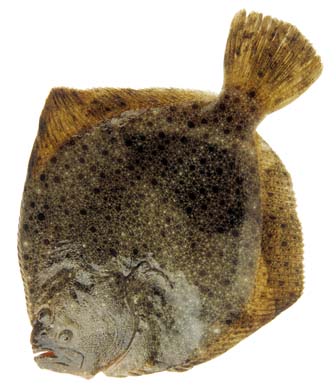
Turbot / Turbo Fish / 多寶魚

Image from guim.co.u

They are highly prized as food fish and they field 4 fillets with the meatier topside portions.[3]


Third on my dad's favourite fish list is ...


Image from blogspot
There are many types of soles and I don't really know which one does my dad like to eat, but he definitely has a taste for flatfishes.


Well, if we don't want to talk about costly fishes here, how about some middle-priced ones?


Image from reef.crc.org.au   
A fish very popular in Thai cuisine, the Barramundi has white, flaky flesh which is particularly smooth when steamed. There are both freshwater and saltwater ones.[4] In Hong Kong, they are often found as farm fish.


Image from redsea.dive.ru


My dad is a real fish lover and he must eat fish every meal. When my dad is home for dinner, he would always ask for this fish. He said it is affordable and the quality is not bad. Well, I don't find many differences between this fish and the Barramundi, except that this one tastes more like freshwater fish.


If my dad doesn't get the Russell's Snapper, he will settle for the Mangrove Red Snapper. Is there any diff?


Image from  wwfsassi.co.za
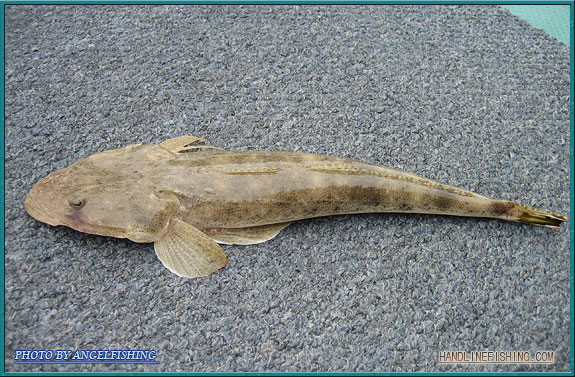
So much about my dad's choices, I am a natural soup lover! I love all kinds of soup, but if I can choose, fish soup always comes first. Topping my list of favourite fish for soup is the ...


Image from Hand Line Fishing
It has two short spikes on either side of the head that contain venom (poison) which is not fatal but can cause pain and infection. Terribly sweet and milky soup! Wide catch.


Second goes to...

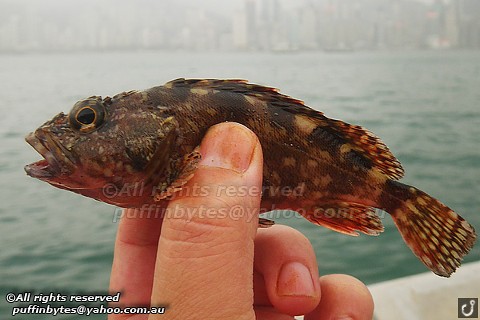
Rockfish / 石狗公

Image from Flickr


Wild catch for sure, lots of bones, tiny and dangerous. One disadvantage, need a lot of them to make a pot of soup. Be careful of the bones when you drink.


In the third place, I have the ...

Small Snakehead / San Pan / 生斑 / (Channa asiatica)
Snakehead / Snake Head Fish / 生魚 / (Channa maculata)


Image from siamfishing
Two types of fish and one big concern -- as National Geographic puts it, "Fishzilla". They produce fast and in huge amount, say 150,000 eggs in 2 years? They are invasive and they cause ecological damage. This fish has already been banned from the USA! Can you imagine that?

Enjoy the fish!
_________________________________________________________________

Vocabulary:
look-alike -- someone or something that is similar in appearance to someone or something else
flaky -- coming off easily in small, flat, thin pieces
Fishzilla -- from the word "Godzilla", a Japanese fictional giant monster. Hereby metaphorically, a monster fish.
fatal -- causes death
invasive -- moving into all areas of something and difficult to stop

_________________________________________________________________

Resources:
http://lockyep.blogspot.com/2009/08/food-groupershong-kong-wet-market.html
http://www1.parknshop.com/WebShop/FishList.do?service=direct&service=1&service=fishListEnu.$DirectLink$4&sp=l12381&sp=SIce-bed+Fish
http://en.wikipedia.org/wiki/Flathead_(fish)
http://www.youtube.com/watch?v=PF2vOp9_hbc

Friday, 12 February 2010

Economics: Anatomy of a Euromess

Hi there! I just read an extremely simple yet informative article on the trouble in Europe right now, and I just can't wait to share with all of you!

For those of you who are interested in economics, let's welcome Dr. Paul Krugman! (Please do search "Krugman" in the Sand Play Area for more entries about him)


(As usual, I hope Dr. Krugman won't mind my quoting of his entire blog entry. Permission not gained for quoting.)


___________________________________________________________________

February 9, 2010, 11:52 AM


Anatomy of a Euromess

Most press coverage of the eurozone troubles has focused on Greece, which is understandable: Greece is up against the wall to a greater extent than anyone else. But the Greek economy is also very small; in economic terms the heart of the crisis is in Spain, which is much bigger. And as I’ve tried to point out in a number of posts, Spain’s troubles are not, despite what you may have read, the result of fiscal irresponsibility. Instead, they reflect “asymmetric shocks” within the eurozone, which were always known to be a problem, but have turned out to be an even worse problem than the euroskeptics feared.

So I thought it might be useful to lay out, in a handful of pictures, how Spain got into its current state. (All of the data come from the IMF World Economic Outlook Database). There’s a kind of classic simplicity about the story — it’s almost like a textbook example. Unfortunately, millions of people are suffering the consequences.

The story begins with the Spanish real estate bubble. In Spain, as in many countries including our own, real estate prices soared after 2000. This brought massive inflows of capital; within Europe, Germany moved into huge current account surplus while Spain and other peripheral countries moved into huge deficit:

DESCRIPTIONIMF

These big capital inflows produced a classic transfer problem: they raised demand for Spanish goods and services, leading to substantially higher inflation in Spain than in Germany and other surplus countries. Here’s a comparison of GDP deflators (remember, both countries are on the euro, so the divergence reflects a rise in Spain’s relative prices):

DESCRIPTIONIMF

But then the bubble burst, leaving Spain with much reduced domestic demand — and highly uncompetitive within the euro area thanks to the rise in its prices and labor costs. If Spain had had its own currency, that currency might have appreciated during the real estate boom, then depreciated when the boom was over. Since it didn’t and doesn’t, however, Spain now seems doomed to suffer years of grinding deflation and high unemployment.

Where are budget deficits in all this? Spain’s budget situation looked very good during the boom years. It is running huge deficits now, but that’s a consequence, not a cause, of the crisis: revenue has plunged, and the government has spent some money trying to alleviate unemployment. Here’s the picture:

DESCRIPTIONIMF

So, whose fault is all this? Nobody’s, in one sense. In another sense, Europe’s policy elite bears the responsibility: it pushed hard for the single currency, brushing off warnings that exactly this sort of thing might happen (although, as I said, even euroskeptics never imagined it would be this bad).

Am I calling, then, for breakup of the euro. No: the costs of undoing the thing would be immense and hugely disruptive. I think Europe is now stuck with this creation, and needs to move as quickly as possible toward the kind of fiscal and labor market integration that would make it more workable.

But oh, what a mess.


______________________________________________

Vocabulary:
peripheral -- happening at the edge of something; neighbouring; namely other members of PIIGS -- Portugal, Italy, Ireland and Greece

______________________________________________


Resources:

Wednesday, 10 February 2010

Food: Festive Puddings

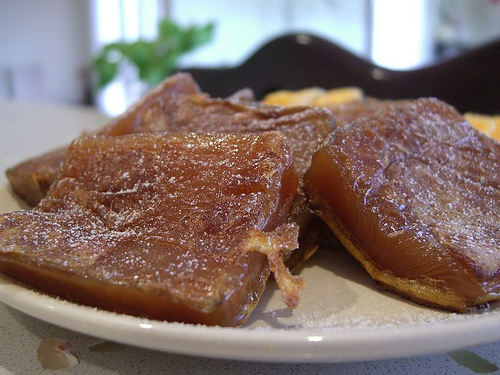
Now, Chinese New Year is just around the corner, and so you should know the names of the festive puddings in English. Some of you have already learnt them from me in the lessons. It is the others turn now.


The Cantonese style is made from glutinous rice (remember my Thai Mango article?) and brown sugar while the Shanghai style is made from white sugar.

Image from wikimedia
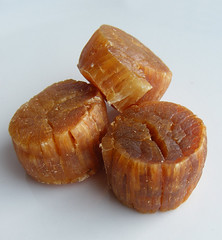
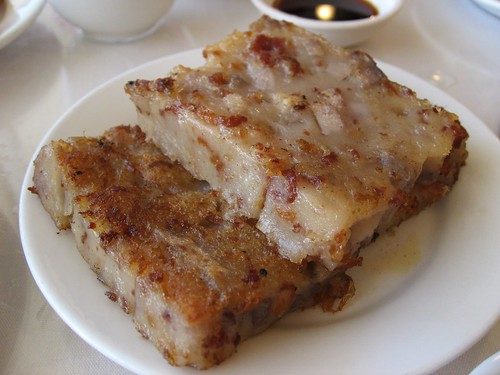
Remember this, the orange colour root is called carrot, the white one is called turnip. Turnip cake is made from plain rice flour and sun-dried shimps. Nowadays, some companies even added conpoy or dried scallops.


Conpoy
Image from flickr
Made from the corm of taro.

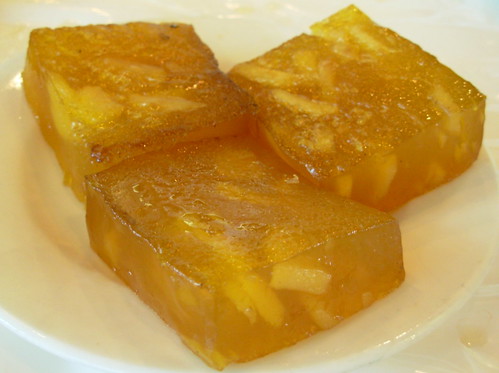
My favourite!!! Made from the corm of water chestnut plant. These days, the new versions also come with a very sweet smelly flower called Osmanthus. The type used in tea and puddings is called Osmanthus fragrans or Sweet Osmanthus.
Image from flickr
Osmanthus
Image from 
blogspot
Don't eat too much guys!!!! It is really easy to get bad stomach these days!!

Resources:
http://en.wikipedia.org/wiki/Year_cake


Monday, 8 February 2010

Learning Method: Grammar First or Vocabulary First?

I really like to read comments from you guys as I will get to know your thinking and feelings towards learning. Your comments offer me the chance to give you more guidance and suggestions, and at the same time, allow me to understand more, so please let me know your troubles in learning, don't keep them to yourselves.

This entry is a response to Phy's comment on the entry Learning Method & Psychology: Why Can't I Speak Fluent English?

A recap of what she said,
"Agree Locky's suggestions
I do think that grammar is more important than other elements. At least I can express my basic meaning of a sentence even though I use a limited vocabularies. Once you build up confidence, you hope to varify your vocabularies.
Sometimes I have chance in speaking English in daily counter duty. I'll memorize some frequently used keywords and sentences. It may be a helpful method to handle daily requests. After the transaction, I usually think the whole conversation again what should I say/ how to express better next time."


In my opinions, sometimes, you do need to memorise expressions related to your work so that you get immediate improvement in your English, like in Phy's case. This is an area of study in English called ESP, English for Specific Purposes. In the long run, however, it is important to build a firm foundation. For me, grammar and vocabulary are both equally important, and I believe they can both be trained at the same time, which is why I started this blog.

But then again, some learners will put more emphasis in grammar, others might opt for vocabulary, everybody's different. The key here is to understand what type of learner you are -- which one you need to more or which you will be more interested to begin your learning with. Eventually, everyone will arrive at the same point of achievement no matter which route you decide to take.

Say for example, if your work requires you to speak perfect English, almost to a native level because your company is filled with westerners, then I suggest you first spend a little time on finding your errors in your spoken English, then correct them through repeated drillings --the "Hear Yourself" method. Once your grammar is fixed, you can pay more emphasis in vocabulary that is related to your work.

On the other hand, if you are bored to death by grammar, then start with vocabulary first. Get to know more about the world through reading fashion magazines, listening to songs, watching movies, etc., find interests in life and in English first before you go deeper into the grammatical aspects of English.

I believe that there is really no such thing as "the only approach" in learning something, only "the most interesting approach" and "the most relevant approach". My choice is always the former one because if you are keen on something, you will work on it!


Resources:
http://lockyep.blogspot.com/2010/02/learning-method-psychology-why-cant-i.html

http://www.blogger.com/posts.g?blogID=8433985884370686932&searchType=ALL&txtKeywords=&label=World

http://www.blogger.com/posts.g?blogID=8433985884370686932&searchType=ALL&txtKeywords=&label=Reading

http://www.blogger.com/posts.g?blogID=8433985884370686932&searchType=ALL&txtKeywords=&label=Songs

http://www.blogger.com/posts.g?blogID=8433985884370686932&searchType=ALL&txtKeywords=&label=Movies