Friday, 5 August 2011

Medical & News: What Causes Cancer? -- Part 2


A joke or the reality? A poster created by an anti-nuclear website
Okay, so our story continues.

Last entry, I left you with a few questions,


  1. Can you prolonged radiation exposure causes cell mutation causes cancer?
  2. Are the construction materials always safe?
  3. Are the construction materials never radioactive enough to harm us?


To answer these questions, first we have to learn something about radioactivity of construction materials.


©Shutterstock, 2010
Radon is released naturally and is not a type of radioactivity
that is released by power plants or industry.
Haquin (?) explains in his article Natural Radioactivity and Radon in Building Materials,

"Most building materials of natural origin contain small amounts of Naturally Occurring Radioactive Materials (NORM), mainly radionuclides from the 226Ra and 232Th decay chains and 40K. Building materials of natural origin reflect the geology of their site of origin. The average 226Ra, 232Th and 40K activity concentration in the Earth's crust is 35, 30 and 400 Bq/kg...

Bricks made from coal ashes
...Recycled industrial by-products containing Technologically Enhanced Natural Occurring Radioactive Materials (TENORM) are extensively used in the construction industry. Coal ash, produced as waste in the combustion of coal, is used as an additive to cement, in concrete and in some countries bricks are made from fly ash. Coal slag is used in floor structures as insulating filling material. Phosphogypsum, a by-product in the production of phosphorous fertilizers is used as building material, and red mud, a waste from primary aluminum production, is used in bricks, ceramics and tiles [3, 4]." (p.1)

A certificate in Chinese stating that their ceramics
is within the accepted radioactivity level
Surprised at how commonly we are exposed to possible high dose of radiation? This does not surprise me at all because I knew this long ago, but definitely surprises some of you. Even in Japan, a country of citizens so detailed, have been using sewage slag as construction material (see Highly Radioactive (170,000 Bq/Kg) Sewage Slag Found In TOKYO, Has Already Been Sold As Construction Material!!!)(13th May, 2011).

Radioactive Slag. Russia.
Photo by Blacksmith Institute.
In addition to these construction materials, there are also others... for example, natural stones.

Laboratory of environmental radioactivity of Russia published on its website,

"Natural stone (or based on it) so called prestige decoration materials usage shows fast and constant increaseThe materials mentioned can have a significant radiation background and can cause negative consequences for men's health with long-duration internal irradiation"


Nathaniel Brooks for The New York Times
DETECTION Using devices like the Geiger counter and the radiation detection instrument Stanley Liebert measures the radiation and radon emanating from granite like that in Lynn Sugarman’s kitchen counters.

Pay special attention to the last sentence, and you'll know, it is possible that one will be exposed to high radiation which will damage a person's health in the long run. Such concern has also been voiced by Dr. Ed Zimney, MD  (2008) in his article Granite and radiation: Are you at risk? and reported by Murphy (2008) on The New York Times article What's Lurking in Your Countertop?

Another source of possible radioactive construction materials is the leaks from nuclear plants.
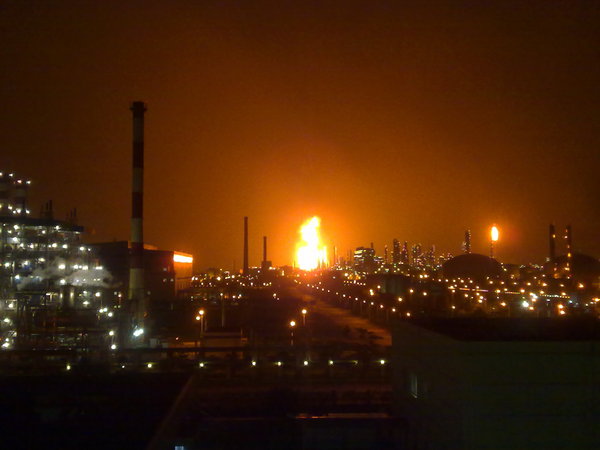
Smoke volume emits from the Huizhou Refinery operated by the China National Offshore Oil Corp inHuizhouGuangdong provinceon July 11, 2011. [Photo/CFP] 
Radiation and Nuclear Safety Authority of Finland -- Säteilyturvakeskus (STUK)  published Guide ST 12.2 on the 17th December 2010 named The Radioactivity of Building Materials and Ash states that,

"some industrial by-products also contain radionuclides, caesium (137Cs) in particular, which are spread into the environment due to fallout from nuclear weapons tests and industrial nuclear accidents. If such a by-product is incorporated into building material, the final product will also contain these artificial radionuclides..."(p.3)


Well, you might be thinking, we don't have any nuclear weapons tests or industrial nuclear accidents near Hong Kong, what's there to worry about???? Idiot Locky!!! 

Well, you haven't been keeping track with the news: Refinery blaze 'never threatened nuke plant' -- China Daily (11th Jul, 2011)

This happened just outside Dayawan Nuclear Power Station.
Firefighters battle a blaze at the Huizhou Refinery operated by the China National Offshore Oil Corp
in Huizhou, Guangdong province, on Monday. Chen Yubin / for China Daily
These things might just be happening more often than you think.

Also, think about it, where are most cement used in Hong Kong made? In Hong Kong? In Guangdong? What about the steel bars? Which part of China? I hope you have some answers in your mind.

In terms of radioactive construction materials, what did our government say?


LCQ5: Construction materials with radioactive substances
Following is a question by the Hon Ho Chung-tai and a reply by the Secretary for Planning and Lands, Mr John C Tsang, in the Legislative Council today (December 5):


Question:

Will the Government inform this Council whether:

(a) the authorities have carried out inspections on buildings completed in the past three years to check if materials with radioactive substances have been used in constructing the buildings; if so, of the results of such inspections;

(b) it has examined the short-term and long-term effects on health of people living or working in the buildings constructed with materials with radioactive substances; and

(c) legislation is in place to regulate the permitted radiation levels of construction materials; if not, whether it will consider introducing legislative control?

Reply:

Madam President,

(a) We have not found the need to carry out specific inspections on buildings completed in the past three years in Hong Kong to check if radioactive substances have been used in building construction. We have been conducting instead periodic surveys on the concentration of radon which, if allowed to accumulate, may pose health risks. Our findings indicate that radon levels found in our buildings are substantially below the level recommended by the World Health Organization for remedial action to be taken.

(b) We have not conducted specific researches on the health effects of people living or working in buildings constructed with materials containing radioactive substances. As I have indicated in Part (a), our survey findings indicate that radon levels found in buildings in Hong Kong are substantially below the level recommended by the World Health Organization for remedial action to be taken.

(c) There is at present no legislation to regulate radiation levels of construction materialsWe have no intention of introducing legislative control at this time because we consider that the health risks arising from radioactive substances in construction materials commonly used in Hong Kong are negligible.

End/Wednesday, December 5, 2001
NNNN

Cement and cement brick. What are they actually made from?
Are they radioactive?
From the above, it is interesting to see that instead of doing real inspections, they did surveys!!!! Surveyed what? The cement answered them? The metals answered them? Or the producers told them?

There is no law to regulate the radiation levels of construction materials and there is no need for one because the radioactivity of such materials are negligible!!! And they know the radioactivity is negligible because they did surverys!!!

What a joke!


"The professional producer of such materials, their refiner and their user are all obligated to inform the next user in the chain of the radioactivity contained by the material...

...the activity concentrations of all stone aggregates used in building element production shall be measured everywhere in Finland."(p.5)

You see the difference between the two governments?

Let's not forget, radioactive substances do not only appear in nuclear plants. They are also used in industries such as industrial radiography (inspecting metal parts and welds defects), irradiators (sterilizing food, milk containers and hospital supplies), well-logging (finding wells), gauging devices (measuring the thickness of metal, textiles, paper, plastic) and many many more. For more information, see NRC: Industrial Uses of Nuclear Materials.

House discovers the source of highly radioactive substance which is killing his patient

So now, am I an idiot? Knowledge is power! 

Trust your doctor friend? Or trust yourself and the Geiger Counter? You choose.


Mary DiBiase Blaich for The New York Times
Geiger counters, which detect radiation, come in a wide variety of shapes and prices.

Vocabulary:
negligible -- (adj) too slight or small in amount to be of importance
oblige (to) -- (vb) [T + object + to infinitive] (mainly US or formal obligateto force someone to do something, or to make it necessary for someone to do something
weld -- (n) a joint made by welding -- weld (vb) [T] to join two pieces of metal together permanently by melting the parts that touch
defect -- (n) [C] a fault, problem or lack (= something that is missing) in something or someone that spoils them or causes them not to work correctly
sterilize 


(UK usually sterilise) 
(vb) 
[T] 
to perform a medical operation on someone in order to make them unable to have children
gauge -- (vb)[T] to calculate an amount, especially by using a measuring device


Resources:

Medical & News: What Causes Cancer? -- Part 1 @ Locky's English Playground


Natural Radioactivity and Radon in Building Materials -- Gustavo Haquin

Highly Radioactive (170,000 Bq/Kg) Sewage Slag Found In TOKYO, Has Already Been Sold As Construction Material!!! @ Infinite Unknown


CONSTRUCTION AND DECORATION MATERIALS USED IN MOSCOW REGION RADIOACTIVITY DATABASE @ LRK-1

Granite and radiation: Are you at risk? -- Dr Z's Medical Report @ everyday HEALTH

What’s Lurking in Your Countertop? @ The New York Times

Radiation and Nuclear Safety Authority of Finland --  Säteilyturvakeskus (STUK) Official Website

The Radioactivity of Building Materials and Ash Guide ST 12.2, publised on the 17th December 2010

Refinery blaze 'never threatened nuke plant' @ China Daily (11th Jul, 2011)

LCQ5: Construction materials with radioactive substances @ Development Bureau Press Releases

NRC: Industrial Uses of Nuclear Materials @ United States Nuclear Regulatory Commission (U.S.NRC)

Geiger Counter @ Wikipedia

Japan’s Nuclear Crisis Causes Run on Radiation Detectors @ The New York Times

Radiation Sickness @ House Wiki

Acute Radiation Syndrome @ Wikipedia

Gamma spectroscopy @ Wikipedia


Wednesday, 3 August 2011

Medical & News: What Causes Cancer? -- Part 1


I was in a dinner with a few really good friends of mine and I proposed prolonged radiation exposure as a possible reason for causing cancers in almost all members of a family, each of which is diagnosed with different types of cancer within a few years.

And I was perceived as an idiot and was immediately rejected by my doctor friend.


Sure enough, radiation may not be the only cause, but my doctor friend should know that cancer is related to both genetics and the environment, so he cannot rule this out unless they have scanned the apartment with a detection metre. If no dangerous level of radiation is found, then we can move on to toxins.

Cancers do not develop overnight, radiation sickness is not necessarily acute, considering all members are all different in their age, having cancers at around the same period of time seem more than a coincidence to me. And, how does he know that their neighbours aren't diagnosed with cancers as well because of the radiation?

Nowadays, how many of us really care about the home we live in? Are the paints we use chemically safe? What about the building materials, are they radioactive-free? What if the steel bars hiding inside your walls are made from scrap recycled metals which is alloyed with radioactive substances? Do you trust the developer of your apartment?

Anyway, before I could make my argument was quickly teased, patronised, ignored and the topic was changed to something else.

But a doctor is still a human, and a human is destined to overlook the importance of something once in awhile, let alone that they might not know what you know, and because I know I am right, so to enforce my point, I decided to find the relevant information. I don't have to show it to my snappy friend to prove that I'm right, but I hope you all can learn something with me.

It is not unusual that you know about something more than a native English speaker, or a teacher, then why is it impossible that you and me know something more than a doctor does?


Here's an article by Dr. Nalini Chilkov, a doctor who has been working with cancer for 30 years ( for her biography, please see here).


What Causes Cancer? Genetics & Environment: The Perfect Storm

Posted: 7/20/11 05:10 PM ET

Why does a woman with no family history of breast cancer and no obvious risk factors for breast cancer succumb to the disease? What happened to her? Today 1 in 8 women in the U.S. is diagnosed with breast cancer. Will you be one of them?
The development of cancer is complex. Many factors contribute to the "perfect storm" of conditions that lead to the presence of cancer cells and your body's inability to stop them from growing.
Discovering all the factors that contribute to the development of cancer in any one individual is not simple. It is complex. And it is usually not exactly the same set of factors for each and every person. Learning more about the toxins in your environment and learning more about your genetics can often help you to take steps to reduce your risk of cancer or cancer recurrence.
There are two primary contributors to the development of cancer: the combination and interaction of your environment and your genetics.
When toxic chemicals in the environment interact with your genetic material, your DNA, which runs your physiology and your immune responses, these toxins can alter and damage normal healthy cell functions. Under these conditions cancer may be primed to develop in your body.
Many believe that certain environmental toxic exposures increase cancer risk. For example, we know that sun exposure can cause skin cancer and that smoking tobacco can cause lung cancer.
But not everyone who spends a lot of time in the sun gets skin cancer. And not every person who smokes cigarettes gets lung cancer. Why not? Most likely it is your genetics.
What does that mean? Most likely the person who spends their life outside in the sun and always has a tan, but never gets skin cancer, has the capacity to meet the challenge of the damage that toxic exposure to sunlight radiation causes. Perhaps that person is able to control inflammation more efficiently due to their genes. Perhaps that person has genetics which are better able to quench the increased oxidative stress that occurs with radiation exposure. Oxidative stress means that lots of free electrons are flying around in and around your cells and are primed to damage your DNA, your genetic material. When your DNA becomes damaged, your cell may lose some of its protective functions and protective intelligence. Depending upon your genetics, you may or may not be able to repair the damage or come up with sufficient protection.
For example, some people can produce more glutathione, your body's own potent antioxidant and cell protectant inside their own cells. This is due to genetics. I may be able to make a lot more glutathione than you can. If, due to your genetics, you make a lot less glutathione in your cells you are going to have less protection from radiation, such as sun exposure and other forms of oxidative stress. Inflammation is another condition that increases oxidative stress inside the cell. What can you do to increase glutathione? High quality whey protein can be added to your diet to enhance glutathione production. The nutritional supplement N-Acetyl Cysteine also increases glutathione inside your cells. Modern medicine actually uses N Acetyl Cysteine in some emergency rooms to protect the patient by reducing the oxidative damage caused by some toxic poisons, including tylenol (acetaminophen) poisoning.
A fair skinned individual may always get a sunburn while another person gets a dark bronze tan and rarely burns. This is due to genetics. The person who gets the tan has genetic programming that leads to the efficient production of melanin, the skin pigment that blocks the sun, your natural sunscreen, and also acts as an antioxidant in the skin. It is known that early humans who roamed outside all day long near the equator had darker skin, a smart evolutionary trait to protect them from the effects of sun exposure. Over time as humans wandered the earth and migrated to northern latitudes wearing skins and furs to protect them from the cold. Farther from the equator, humans had less need for melanin rich dark skin. If your ancestors come from northern latitudes they may have fair skin and be at higher risk for skin cancer because they have lost the skin's natural ability to protect itself from the sun by producing dark pigmentation.
The tars, resins and nicotine in tobacco can cause lung, mouth and throat cancers. However, you may not be able to repair the damage caused by these chemicals while your best friend with different genetics may be able to repair damaged DNA and metabolize or detoxify those noxious substances and transform them into less caustic and damaging by products or metabolites. You will have a higher risk of getting cancer from smoking, while she may have a lower risk due to different genetics.
We have a large and diverse group of enzymes in our bodies called the Cytochrome P450 system that is designed to transform toxic chemicals in our cells into non toxic less damaging, less toxic forms that won't damage our tissues and our DNA. According to your genetics, you may have different versions of these enzymes. One person may be a lifelong smoker and never get lung cancer, while another person will develop cancer due to a difference in the P450 enzymes they make in their body. Blood tests are now available to look at these important detoxification enzymes. You may be able to learn which chemicals and drugs are the most problematic and dangerous for you. This is often referred to as genomic testing.
Another chemical that is ubiquitous in the modern industrial environment, benzene, is known to be a carcinogen, a cancer causing chemical. Studies of workers exposed to high levels of benzene, such as those in the chemical, shoemaking and oil refining industries demonstrate higher rates of cancer. Yet, not all workers in these industries get cancer? Why not? The answer is "Different Genes." Some people will have more efficient and effective cell protection and some people will have better P450 detoxification functions than others. Wouldn't it be good to know if choosing a certain profession, industry or hobby would increase your chances of getting cancer?
Genetics determines how an individual woman will metabolize her own estrogen, the estrogen made inside her own body. Some women will metabolize their own estrogen into highly cancer causing metabolites and other women will not. We can actually measure this in the urine. For a woman who has genes that tip her toward cancer and other diseases related to too much estrogen exposure because of the way she processes her own hormones, we can test her urine and identify this trait and susceptibility. Then we can do something about it. Some experts believe we can shift the way a woman handles her own estrogen. They also believe we can give her herbal medicines and foods to cause her estrogen to be metabolized down a less cancer causing pathway. They also believe we can change her cancer risk with food.
It is widely believed that plant chemicals called sulphoraphanes will change how a woman metabolizes her own hormones. Sulphoraphanes are found in high amounts in the cabbage vegetable family and are especially high in kale and broccoli. For the woman who does not eat these foods on a regular basis in her diet, she may choose to take an encapsulated form as an insurance policy.
In medicine today we are able to test for many of these enzymes and genetic traits. By discovering the unique patterns in your genetics you can discover where you are most vulnerable. This may mean that you decide to avoid exposure to certain chemicals that will be more toxic and damaging for you due to your genetics. This is the age of personalized medicine.
Or you may decide to change your diet and add foods that are high in potent plant antioxidants and anti cancer chemicals that alter hormone metabolism. Nature has provided us with a plethora of foods that have anti-cancer activity.
Your food is talking to your genes everyday. What you eat matters.
I have written a free 30 page report: Three Dangerous Cancer Survival Myths RevealedWhat Your Doctor Is Not Telling You in which I list over fifty foods that are known to have anticancer properties. I have also included steps you can take to make your home a non toxic cancer free zone. Get instant access to this free report now and start protecting yourself and your family from cancer today.
For more on Integrative Cancer, Health and Healing visit my blog
You May Also Like:
Follow Dr. Nalini Chilkov on Twitter: www.twitter.com/doctornalini


After reading this article, can you simply rule out prolonged radiation exposure causing cell mutation causing cancer?

Still think I'm wrong? That the construction materials are always safe and are never radioactive enough to harm us? Wait till you read my next entry.


Vocabulary:

genetics -- (n)[U] the study of how, in all living things, the characteristics and qualities of parents are given to their children by their genes
scrap -- (n) [U] old cars and machines or pieces of metal, etc. that are not now needed but have parts that can be used to make other things
tease -- (vb) [I or T] to laugh at someone or say unkind things about them, either because you are joking or because you want to upset them
patronize -- (vb) [T] disapproving (UK usually patronise) to speak to or behave towards someone as if they are stupid or not important
destined (to) -- (adj) controlled by a force which some people believe controls what happens, and which cannot be influenced by people
let alone -- (adv) used after a negative statement to emphasize how unlikely a situation is because something much more likely has never happened
snappy -- (adj) from snap (vb) [I] to suddenly become unable to control a strong feeling, especially anger
succumb (to) (vb)  [I] formal to die or suffer badly from an illness
toxin -- (n) [Ca poisonous substance, especially one which is produced by bacteria and which causes disease
recurrence -- (n)  [C or Uhappening many times or to happen again
alter -- (vb) [I or T] to change something, usually slightly, or to cause the characteristics of something to change
prime -- (vb) [T] to tell someone something that will prepare them for a particular situation
quench -- (vb) [T] literary to cause a fire to stop burning with water
equator -- (n) [S] an imaginary line drawn around the middle of the Earth an equal distance from the North Pole and the South Pole
metabolize -- (vb) [I or T] about metabolism -- (n) [S] the set of chemical reactions that happen in living organisms to maintain life.
detoxify -- (vb)  [I or Tto remove harmful chemicals from something 
noxious -- (adj) formal describes something, especially a gas or other substance, that is poisonous or very harmful
caustic -- (adj) describes a chemical that burns or destroys things, especially anything made of living cells
ubiquitous -- (adj)  formal or humorous seeming to be in all places
carcinogen -- (n) [C] a substance which causes cancer
estrogen / oestrogen -- (n) [U] a female hormone that causes development and change in the reproductive organs
urine -- (n) [U] the yellowish liquid waste which is released from the body when you go to the toilet
trait -- (n) [C] a particular characteristic that can produce a particular type of behaviour


Resources:

Dr. Chilkov Biography @  Huffington Post

What Causes Cancer? Genetics & Environment: The Perfect Storm @ Huffington Post

Radiation Sickness @ House Wiki

Acute Radiation Syndrome @ Wikipedia