Sunday, 13 July 2014

News: "Olds" That Shock The World This Week!


Child infected with smallpox. Bangladesh, 1973
Image from Wikipedia
As the title goes, here are some "olds" that shock the world in the past few days!

Employees at the National Institutes of Health (NIH) discovered 6 forgotten vials of the horrific, catastrophic smallpox virus in an unused storage room in early July, the Centres for Disease Control and Prevention (CDC) said.
Smallpox virus under microscope
Image from nbcnews
Smallpox structure
Image from scq.ubc.ca

A disease believed to have originated over 3,000 years ago in India or Egypt, smallpox killed an estimated 300–500 million people during the last century. Typically characterised by dense dimpled pustules rash filled with thick, opaque fluid, smallpox has a very high case-fatality rate ranging from 20% to 60% in adults and near 80% in London and 98% in Berlin during the late 1800s  in infants.

Image from Wikipedia

One of the minor differences between smallpox and chickenpox is the distribution of the rash, as chicken pox rash appears mainly on the face and the torso, whereas smallpox focuses attack on the face and limbs.

Since the introduction of vaccination in the 1800, smallpox was officially eradicated worldwide in 1979, except for samples stored in 2 highly secure laboratories, consisting of CDC and Russia. The vials concerned in this "olds" which should have been destroyed have been left unsecured for decades. The fact that the virus did not end in a massive outbreak and "rebirth" of smallpox, we are all very lucky.

This image of Steven Spielberg following what appears to be a triceratops poaching has gone viral.
Photo: Jay Branscomb, Facebook. Caption by KSDK.com
Sarcasm and humour at work. A Facebook jokester posted an image of Steven Spielberg sitting in front of a Jurassic Park Triceratop prop with the caption:


"Disgraceful photo of recreational hunter happily posing next to a Triceratops he just slaughtered. Please share so the world can name and shame this despicable man."

The comments are the best part.

"Steven Spielberg, I'm disappointed in you. I'm not watching any of your movies again ANIMAL KILLER," one commenter wrote.
"Disgraceful. No wonder dinosaurs became extinct. Sickos like this kill every last one of them as soon as they are discovered. He should be in prison," another said.
"He should be killed instead. Beautiful creature innocently living millions of years ago then this monster comes along," the commenter said.
"That's Steven Spielberg, director of Jurassic Park!" one person wrote.
"I don't care who he is, he should not have shot that animal!" a defender all of animals (even extinct ones) wrote back.
Do you think they really do not know what is happening, or are they just being funny and play along?

Google Glass crossover Brainwave detection?
Image from ddmcdn
Loved or hated, Google Glass can now be controlled using brainwave!!! How? The video below will tell.


In the future, the patients with locked-in syndrome (LIS) may be able to communicate! Awesome technology!


Finally, scientists have come up with another theory on how massive pyramid rocks were moved, and they say -- water.


What do you think?


Vocabulary:
pustule -- (n)[C] 
jokester -- (n)[C] 


Resources:
'Holy Toledo': Smallpox Discovery Opens Painful Scabs @ NBC News.com
http://www.nbcnews.com/health/health-news/holy-toledo-smallpox-discovery-opens-painful-scabs-n153141

David A. Koplow (2004) Smallpox: The Fight to Eradicate a Global Scourge
http://books.google.com.hk/books/ucpress?vid=ISBN9780520242203&redir_esc=y

Smallpox at @ WHO
http://web.archive.org/web/20070921235036/http://www.who.int/mediacentre/factsheets/smallpox/en/

Edward Jenner and the history of smallpox and vaccination @ NCBI
http://www.ncbi.nlm.nih.gov/pmc/articles/PMC1200696/

Steven Spielberg: Triceratops murderer? @ KSDK.com
http://www.ksdk.com/story/life/2014/07/11/steven-spielberg-triceratops-murder/12551901/

Good Thinking! Brain-Control Google Glass @ Discovery News
http://news.discovery.com/tech/gear-and-gadgets/good-thinking-brain-control-google-glass-140710.htm?utm_source=googleplus.com&utm_medium=social&utm_campaign=DNewsSocial

MindRDR @ YouTube
http://www.youtube.com/watch?v=JJQZtxlLaG0

Locked-in syndrome @ Wikipedia
http://en.wikipedia.org/wiki/Locked-in_syndrome

We Finally Know How The Pyramids Were Made! @ YouTube
http://www.youtube.com/watch?v=hRvtVrXcC3Y


Thursday, 10 July 2014

Food & Cooking: Japanese Slow-Cooked Teriyaki Flounder


Japanese Slow-Cooked Teriyaki Flounder
Image from Locky's English Playground
Not much time to write too much, and so, a quick sharing of yet another quick and easy dish from me -- the Japanese Slow-Cooked Teriyaki Flounder!

You'll need,
  1. a fish (salmon, flounder, etc.),
  2. Japanese Teriyaki sauce,
  3. Mirin,
  4. rice wine or Sake;
  5. ginger,
  6. spring onions (optional)
Fish and ginger? In!
Image from Locky's English Playground
Step 1: Dump the fish and ginger into a pot.

Sauces ready!
Image from Locky's English Playground
Step 2: Pour one portion of Japanese Teriyaki sauce, half a portion of Mirin and 1/4 portion of rice wine or Sake into the pot.

La la la la la!
Image from Locky's English Playground
Step 3: Mix well.


Cook for 20 mins
Image from Locky's English Playground
Step 4: With small flame, cook the fish for 20 mins.

Image from Locky's English Playground
Step 5: Add decorations such as spring onions and get ready to eat!!!

Enjoy!

PS: Please note that the rice wine and ginger are essential, or else you will get that fishiness with every bite!


Monday, 7 July 2014

Movie: Movies In Real Life -- A Series


"Do you know where the park is?
Image from Improv Everywhere @ YouTube
Want to find some videos for listening practice? Here you go!

Classic movies are classic because they are classic! Does that make any sense to you? No? But surely you remember these moments, and the fact that you, and all those in the videos below remember them tell us that they are classic for a reason!


With Jurassic World coming to theatre in 2015, I really want to see more of these dino-actions to build up the hype!!


They are so cool! Life is so much fun with these creativity!

Can Hong Kong accommodate such creativity? People say yes, government says no...


Vocabulary:
hype -- (n)[U] informal a situation in which something is advertised and discussed in newspapers , on television , etc. a lot in order to attract everyone's interest :


Resources:
Jurassic Park In Real Life - Movies In Real Life (Episode 6) @ YouTube
http://www.youtube.com/watch?v=_7fHkq88J0E&index=6&list=PLTNjsbzFjWTA3-yF32hvWVkWU5kjDA3Ax

Harry Met Sally Orgasm Scene Prank - Movies In Real Life (Ep 7) @  YouTube
https://www.youtube.com/watch?v=shC016PnxPs

Harry Potter In Real Life - Movies In Real Life (Episode 8) @ YouTube
http://www.youtube.com/watch?v=F3XTAw3tzyI&index=8&list=PLTNjsbzFjWTA3-yF32hvWVkWU5kjDA3Ax

Star Wars Subway Car - Movies In Real Life @  YouTube
https://www.youtube.com/watch?v=J5gCeWEGiQI

Jurassic World (2015) @IMDb
http://www.imdb.com/title/tt0369610/?ref_=nv_sr_1

http://dictionary.cambridge.org/dictionary/british/hype_1?q=hype

Wednesday, 2 July 2014

IPA: Is It Possible to Have Primary-Stressed Vowels In An English Word?


"There is no agreed phonetic definition of a syllable" -- Ladefoged (1982, p219)
Image from Peter Ladefoged's homepage
"There is no agreed phonetic definition of a syllable" -- Ladefoged (1982, p219)

Last year, one of my students who happens to be an IPA teacher with a Master's degree in  Translation, spotted something pretty interesting when I was introducing the word "masseur".
Image from Cambridge Dictionary Online

She argued that the stress mark should be before the /s/ not after it, according to the rules she has learnt. She suspected that this is a typo made by Cambridge University.

To my knowledge, having a primary stress on a vowel alone is not unusual at all, according to my hundreds of hours of blog-writing (thus my exploitation of the Cambridge Dictionary Online), but at that moment, I couldn't come up with a counter-example. She was convinced with what she knew and stressed that by telling me she was an IPA teacher, and I was also sure with what I know, and so she challenged me to find another example on the Cambridge Dictionary Online, or if the same word "masseur" shows up with the same IPA. Subsequently, the situation got worse and I even received a complaint from her through my boss. My ex-boss, who is a fervent supporter of the Oxford Dictionary, was on her side and instructed me never to teach IPA in class again because "you are wrong!" I found no point of arguing with her and also pointless to even think about educating her, and so I pretended to have accepted her view.

Why should I make her smarter if they insist that they are smarter, right?

But am I really wrong? Of course not, not in this case. What they do not know is the most fundamental concepts of pronunciation.

Now that things have cooled down, I can explain the logic and reasons behind.

Notice the difference in IPA for the same word by different dictionaries
Image from Academic Dictionaries and Encyclopedias

Now, here's something we must know. If we check different authoritative dictionaries, we are bound to get many different IPA representations for the same word. How's that possible?

The answer is both political and commonsensical

It is political because of the way these dictionary authorities, such as Cambridge, Oxford, BBC, Colins, Longman, Webster, Merriam-Webster, etc., they are not friends and they don't share their researches. Sponsors or funded money is spent on top-secret data collections, data processing and computer programs

It is also commonsensical since they basically use different algorithms to work on different lexico-grammatical and phonological data collected from different regions of the world, few, if any, of the linguistic features such as IPA, grammar, meanings, translations will be the same. Why would it be the same anyway if there is something called copyright and patent infringement? Just ask Apple Inc. about copyrights and patents! 

What's more, I believe that there is in fact no 100% foolproof rule to anything on this planet. I used to believe that there is something that is absolutely right and absolutely wrong when I was a kid, just to realise that there are something called grey areas eventually. 

When a theory or a rule is wrong, people set a new boundary and then set a new rule, and the new rule remains correct until someone disproves it. The subject of science works exactly this way. Remember that our Earth was once believe to be a cube and travelling too far off the ships would fall off the edge of the world?

Let's not forget, we are dealing with English, a language which has borrowed, devoured, digested and "stolen" from over 350 languages around the world since 450 AD, sometimes, or most of the time, which English word belongs to which language is a tough task to trace. Then how can one IPA rule bound every word in the English language? Quite impossible.

Anyway, I find this question really challenging and here's what I've found!


Images from Cambridge Dictionary Online

All of them, with the exception of "batik" which is from Dutch, are from French.


Could this primary-stressed vowel pattern mainly happens in French loanwords? I doubt it. Dutch, in particular, is well-known for their stressed vowels. 

Could this primary-stressed vowel pattern only appears in Cambridge Dictionary Online? Not sure, but I checked every one of these words in the Oxford Dictionaries, and none of them shows this pattern.


Images from Oxford Dictionary Online

Anyway, I would very much like a clarification on that from the Cambridge University Press to make my student happy, so I wrote Cambridge University Press an email at 1:45am (now it's 2:33am, 26th July 2013), the response that I received was, they will follow up, and they never did.

That being said, you can try searching words like "ergo", "earnings", "urgent", "also", always", "pronunciation" and see the same pattern of primary-stressed vowel.

Back to my point, I believe that there is hardly any rules which can always be true (this is something I have learnt from Dr. House), pronunciation models are forever changing as humans evolve, what the quote from Ladefoged back in 1982 at the beginning of this post is very much still valid today, even with the advance technology that we possess right now. Syllabification, the separation of a word into syllables, whether spoken or written, is a complex topic in linguistics study and like everything academic, it is heavily argued and debated.

I must say I do not know everything, but you do not need to be a genius to know that nothing is true forever.

So, as common learners of English, whether you belong to the ESL, EFL, ESP or EAP group, when learning IPA, I have one advice -- don't be too rigid.

"Empty your mind, be formless, shapeless, like water." -- Bruce Lee

The Analysis of French Schwa
Image from Jstor
Image from Wiktionary

For more articles on IPA, do visit my IPA page.


Vocabulary:
masseur -- (n)[C] a person whose job it is to give massages to people
typo -- (n)[C] informal a small mistake in a text made when it was typed or printed
fervent (also fervid) formal-- (adj) describes beliefs that are strongly and sincerely felt or people who have strong and sincere beliefs
authoritative -- (adj) containing complete and accurate information , and therefore respected
commonsensical -- (adj) the basic level of practical knowledge and judgement that we all need to help us live in a reasonable and safe way
bound to do sth-- certain to do something; destined to do something.
foolproof -- (adj) (of a plan or machine ) so simple and easy to understand that it is unable to go wrong or be used wrongly
devour -- (vb)[T] to eat something eagerly and in large amounts so that nothing is left
trace -- (vb)[T] to find the origin of something
syllabification or syllabication -- (n)[U] the separation of a word into syllables, whether spoken or written.


Resources:

IPA @ Locky's English Playground
http://lockyep.blogspot.hk/search/label/IPA

IPA & Website: Peter Ladefoged's IPA Home Page @ Locky's English Playground
http://lockyep.blogspot.hk/2010/10/ipa-website-peter-ladefogeds-ipa-home.html

The History of English in 10 Minutes @ YouTube

http://www.fon.hum.uva.nl/diana/papers/Chapter_2_Grammatical_vs_Lexical_Stress.pdf

Stress @ Wikipedia
http://en.wikipedia.org/wiki/Stress_(linguistics)

The Analysis of French Shwa : Or, How to Get Something For Nothing? @ Jstor
http://www.jstor.org/discover/10.2307/413848?uid=3738176&uid=2134&uid=367753221&uid=2&uid=70&uid=3&uid=367753211&uid=60&sid=21101650914611

Whatever happened to Received Pronunciation? J.C. Wells, UCL
http://blog.sina.com.cn/s/blog_4a7c82560101nvlj.html

Ladefoged, P. 1982. A Course in Phonetics (2nd ed.). New York: Harcourt Brace Jovanovich

Syllabification @ Wikipedia
http://en.wikipedia.org/wiki/Syllabification

Phonetic cues to syllabification
http://escholarship.org/uc/item/2497n8jq#page-112


http://dictionary.cambridge.org/dictionary/british/masseur?q=masseur
http://en.wiktionary.org/wiki/masseur#French
http://idioms.thefreedictionary.com/bound+to+do
http://dictionary.cambridge.org/dictionary/english-chinese-traditional/foolproof?q=foolproof+
http://dictionary.cambridge.org/dictionary/english-chinese-traditional/devour?q=devour+
http://dictionary.cambridge.org/dictionary/english-chinese-traditional/trace_1?q=trace+
http://dictionary.cambridge.org/dictionary/english-chinese-traditional/common-sense?q=commonsensical+
http://dictionary.cambridge.org/dictionary/english-chinese-traditional/fervent?q=fervent
http://dictionary.cambridge.org/dictionary/english-chinese-traditional/authoritative?q=authoritative+
http://dictionary.cambridge.org/dictionary/english-chinese-traditional/typo?q=typo


Tuesday, 1 July 2014

Cooking & Food: Battle Of The Udon -- Stage 3

Can anyone of the 4 udons dethrone the mighty ACE Sanuki Udon?
Image from Locky's English Playground
Surely, one will easily get hungry when watching soccer past midnight (HK time), getting sick of instant noodles? Maybe it is time for some "udoniousness", so back is our Cooking & Food: Battle Of The Udon -- Stage 3

First, a quick reminder the results from Stage 2:

Results from Stage 2
(Left to Rigth) ACE Sanuki Udon, ACE Japanese Udon (Hand-made Style), ACE Shikoku Sanuki Udon, Menyuraku Sanuki Zaru Udon Noodle, Japan Furusato Sodachi Udon Image from Locky's English Playground

Round 1 -- Price
Winner: ACE Shikoku Sanuki Udon -- HK$3.29/100g

Round 2 -- "Dry length" of udon noodle
Winners: ACE Sanuki Udon and ACE Japanese Udon  -- 24.7cm and 24.5cm respectively

Round 3 -- Cooking time of the udon noodle
Winners: Menyuraku Sanuki Zaru Udon Noodle --  6 mins

Round 4 -- The "Stretch" of the udon noodle
Winner: Menyuraku Sanuki Zaru Udon Noodle -- (25.8 - 20.2) / 20.2 x 100% = 27.7%

Round 5 -- Edibility! 
Winner: ACE Sanuki Udon

Overall "Battle Of The 4 Udon" Stage 2 Winner !
ACE Sanuki Udon (again!)

And so ACE Sanuki Udon has won two battles in a row, although it may not be the tastiest udon or the cheapest, it is ranked way up there with the best, thus it really deserves to be the overall champion in both battles, but can it stand the 3rd test of time? Or will it finally be dethroned?

Let's kick off Battle Of The Udon -- Stage 3!!!

Here comes the new challengers!!!
Image from Locky's English Playground

This time round, we have 4 challengers for the two-time champion, Itsuki Hakata Udon is priced very close to ACE Sanuki UdonIshimarus Futo-Udon/Thick type has an awesome-looking smooth non-glossy packaging, Yamamoto Seifun Udon is selling how its udon can be served hot and cold while forgetting to put the company logo in front, while Hato Dried Noodle Udon too, having no company name or logo, comes with a simplistic packaging.

Round 1 :  Price-Per-100g!


ACE Sanuki Udon
Image from Locky's English Playground


Itsuki Hakata Udon
Image from Locky's English Playground


Ishimarus Futo-Udon/Thick type
Image from Locky's English Playground


Yamamoto Seifun Udon
Image from Locky's English Playground

Hato Dried Noodle Udon
Image from Locky's English Playground


Like Stage 2, the udon prices are calculated according to the price bought. 

In Stage 3, our four contestants from left to right, up then down, all bought from AEON / JUSCO Supermarket, are:
  • ACE Sanuki Udon, 400g, HK$19.9
  • Itsuki Hakata Udon, 400g, HK$20.9
  • Ishimarus Futo-Udon/Thick type, 500g, HK$32.9
  • Yamamoto Seifun Udon, 400g, HK$21.9
  • Hato Dried Noodle Udon, 270g, HK$15.9
And the Price-Per-100g is listed below:
  • ACE Sanuki Udon                                    -- HK$4.98/100g
  • Itsuki Hakata Udon                                  -- HK$5.23/100g
  • Ishimarus Futo-Udon/Thick type             -- HK$6.58/100g
  • Yamamoto Seifun Udon                           -- HK$5.48/100g
  • Hato Dried Noodle Udon                         -- HK$5.89/100g
And what do you know, ACE Sanuki Udon is the most inexpensive udon this time round! I wonder how many shoppers will notice this price-per-100g figure before they buy?

Sorry, some udon have already been eaten before taking all subsequent photos, that is, a bunch is obviously missing from some packets
Image from Locky's English Playground
Congratulations to ACE Shikoku Sanuki Udon for grabbing the first win in Round 1! Looks like ACE Shikoku Sanuki Udon is off to a great start today!


Round 2: The "dry length" of udon noodle.

Here are the measurements:

ACE Sanuki Udon -- 24.5cm
Image from Locky's English Playground

Itsuki Hakata Udon -- 19.9cm
Image from Locky's English Playground

Ishimarus Futo-Udon/Thick type -- 24.2cm
Image from Locky's English Playground

Yamamoto Seifun Udon -- 19.2cm
Image from Locky's English Playground

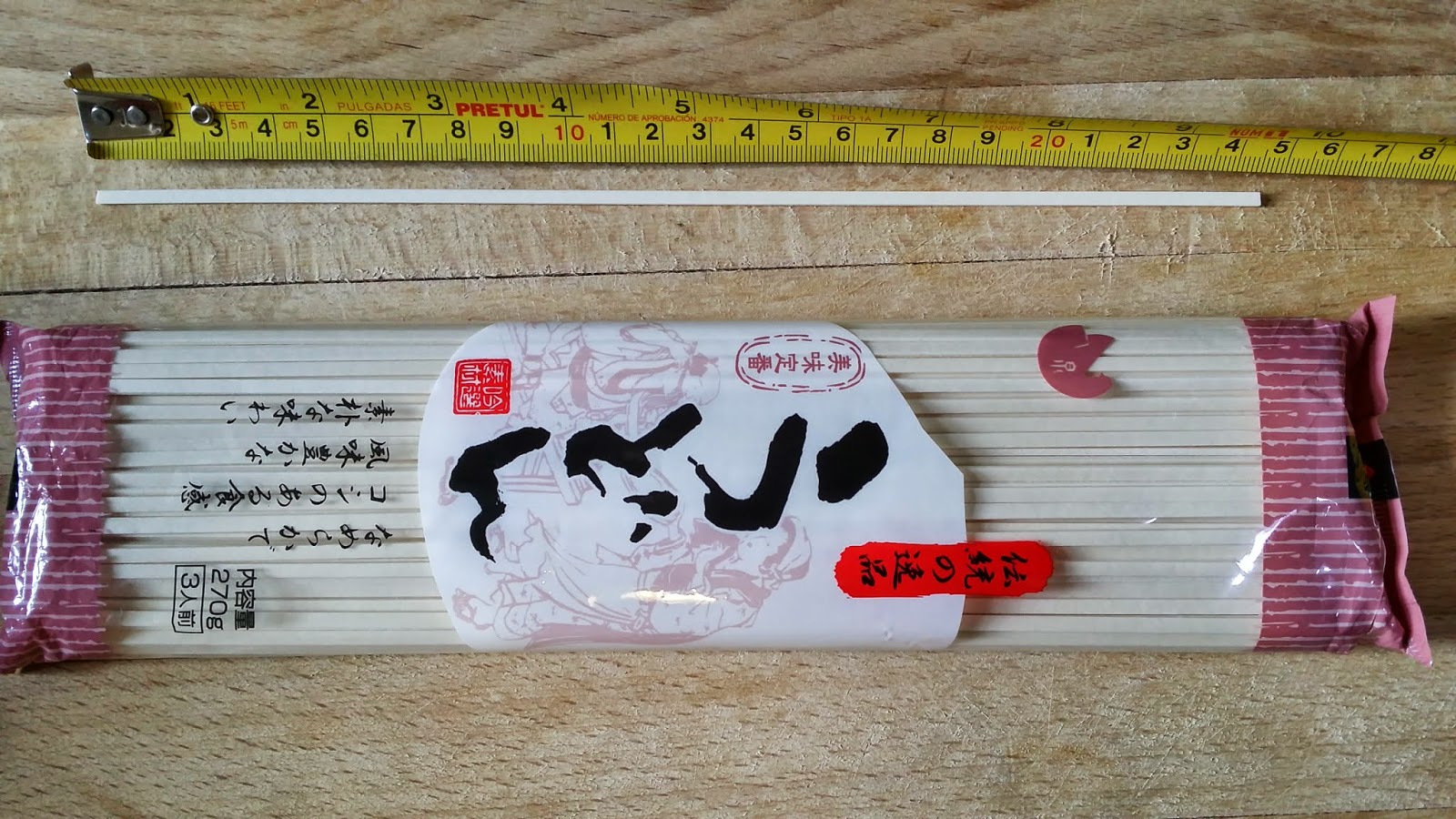
Hato Dried Noodle Udon -- 24.5cm
Image from Locky's English Playground


After measuring, the results are:
  • ACE Sanuki Udon                          -- 24.5cm
  • Itsuki Hakata Udon                        -- 19.9cm
  • Ishimarus Futo-Udon/Thick type    -- 24.2cm
  • Yamamoto Seifun Udon                  -- 19.2cm
  • Hato Dried Noodle Udon                -- 24.5cm
When it comes to length, we have 3 udon very close in length with each other, and so I am going to award this one to 3 udons measured around the length of 24cm!

Congratulations to ACE Sanuki Udon, Ishimarus Futo-Udon/Thick type and Hato Dried Noodle Udon for winning Round 2!


Round 3: Cooking time of the udon noodle
(Left to Right) ACE Sanuki Udon  -- 10 mins, Itsuki Hakata Udon -- 15 mins, Hato Dried Noodle Udon -- 7 mins
Image from Locky's English Playground

(Left to Right) Ishimarus Futo-Udon/Thick type -- 18 mins, Yamamoto Seifun Udon -- 10 mins
Image from Locky's English Playground
All together, the result is as follows:
  • ACE Sanuki Udon                                    -- 10 mins
  • Itsuki Hakata Udon                                  -- 15 mins
  • Ishimarus Futo-Udon/Thick type              -- 18 mins
  • Yamamoto Seifun Udon                            -- 10 mins
  • Hato Dried Noodle Udon                          -- 7 mins
Ishimarus Futo-Udon/Thick type needs 18 mins for cooking? I really do not get it! Hato Dried Noodle Udon takes this one!

Congratulations to Hato Dried Noodle Udon  for winning Round 3!


Round 4 of the battle is the "Stretch" of the udon noodle

the stretch of each udon!!! This time, apology to the missing close-ups photo of the Yamamoto Seifun Udon.


ACE Sanuki Udon -- 30.9cm
Image from Locky's English Playground

ACE Sanuki Udon -- 30.9cm
Image from Locky's English Playground
Yamamoto Seifun Udon -- 25cm
Image from Locky's English Playground
Itsuki Hakata Udon -- 25cm
Image from Locky's English Playground
Itsuki Hakata Udon -- 27cm
Image from Locky's English Playground
Itsuki Hakata Udon -- 27cm
Image from Locky's English Playground
Ishimarus Futo-Udon/Thick type -- 30.1cm
Image from Locky's English Playground
Ishimarus Futo-Udon/Thick type -- 30.1cm
Image from Locky's English Playground
Hato Dried Noodle Udon -- 29 cm
Image from Locky's English Playground


All together, the result is as follows:
  • ACE Sanuki Udon                                    -- (30.9 - 24.5) / 24.5 x 100% = 26.1%
  • Itsuki Hakata Udon                                  -- (27.0 - 19.9) / 19.9 x 100% = 35.7%
  • Ishimarus Futo-Udon/Thick type              -- (30.1 - 24.2) / 24.2 x 100% = 24.3%
  • Yamamoto Seifun Udon                            -- (25.0 - 19.2) / 19.2 x 100% = 30.2%
  • Hato Dried Noodle Udon                          -- (29.0 - 24.5) / 24.5 x 100% = 18.4%
From the percentage, we can see that, if you want to have more filling sensation but wants to lower the carb intake, you should go for Itsuki Hakata Udon with 35.7% increase in length! Another surprise is that Ishimarus Futo-Udon/Thick type takes the longest time to cook but has almost the smallest percentage of "stretch".

Congratulations to Itsuki Hakata Udon for winning Round 4!


Round 5, the final round of the battle, is Edibility! 

The judges here are my wife, who did not know which udon she would be eating, and I myself, with my wife's opinions taking the most weight. The whole process was recorded and typed out by me.
  • ACE Sanuki Udon                                    -- toughest, taste slightly salty
  • Itsuki Hakata Udon                                  -- tough, bland
  • Ishimarus Futo-Udon/Thick type              -- too soft, disgusting, very bland
  • Yamamoto Seifun Udon                            -- soft, like Chinese ho fun, taste bland
  • Hato Dried Noodle Udon                          -- tough, but not chewy, taste ok
And here's her rank:
  1. Hato Dried Noodle Udon
  2. ACE Sanuki Udon
  3. The rest
Congratulations to Hato Dried Noodle Udon for winning Round 5!

I will now add my own opinions into the judgement and present to you my choice of Stage 3 winner, but before I reveal the answer, let me do a quick summary of our current winners:

  • Itsuki Hakata Udon -- Winner of Stretch
  • Hato Dried Noodle Udon -- Winner of Shortest Cooking Time
  • ACE Sanuki Udon, Ishimarus Futo-Udon/Thick type and Hato Dried Noodle Udon --  Winners of Dry Length
  • Hato Dried Noodle Udon -- Winner of Edibility
  • ACE Sanuki Udon -- Winner of Price-Per-100g

I will have to say that this time round, the competition is not as tight as the previous 2 battles. We know that price is not everything when it comes to food, but surely, Ishimarus Futo-Udon/Thick type at HK$6.58/100g turns out to be the most expensive in terms of purchasing and use of gas in that 18 mins of cooking. Good packaging is now proven to be a poor reference to good udon.

Yamamoto Seifun Udon and Itsuki Hakata Udon, one word for them, mediocre.

The finalists boils down to ACE Sanuki Udon and Hato Dried Noodle UdonACE Sanuki Udon has shown us once again its positioning is among the most competitive in this aspect, at the other end, Hato Dried Noodle Udon is the most costly of the badge, whether being the smallest packet scares or attracts customers is an interesting research topic, but smaller packet does mean that it is going for the premium customers rather than general household consumers. Has it then reached that level of taste requirement of the premium customers then? The answer is definitely no.

And so, for the most consistent udon, we have, and yes, once again,

ACE Sanuki Udon wins 3 times in a row!!!
Image from Locky's English Playground
Congratulations to ACE Sanuki Udon 讃岐うどん for becoming Locky's English Playground, "Battle Of The Udon" Stage 3 Winner !

I am starting to think if there will be any other udon out there that can defeat the brilliant ACE Sanuki Udon.

There will be the Battle Of The Udon -- Stage 4, till then, I know which one is the best!


Vocabulary:
stand the test of time -- If something stands the test of time , it is still popular , strong , etc . after a long time
dethrone -- (vb)[T] to beat someone who is the best at something, especially a sport , and become the best yourself